
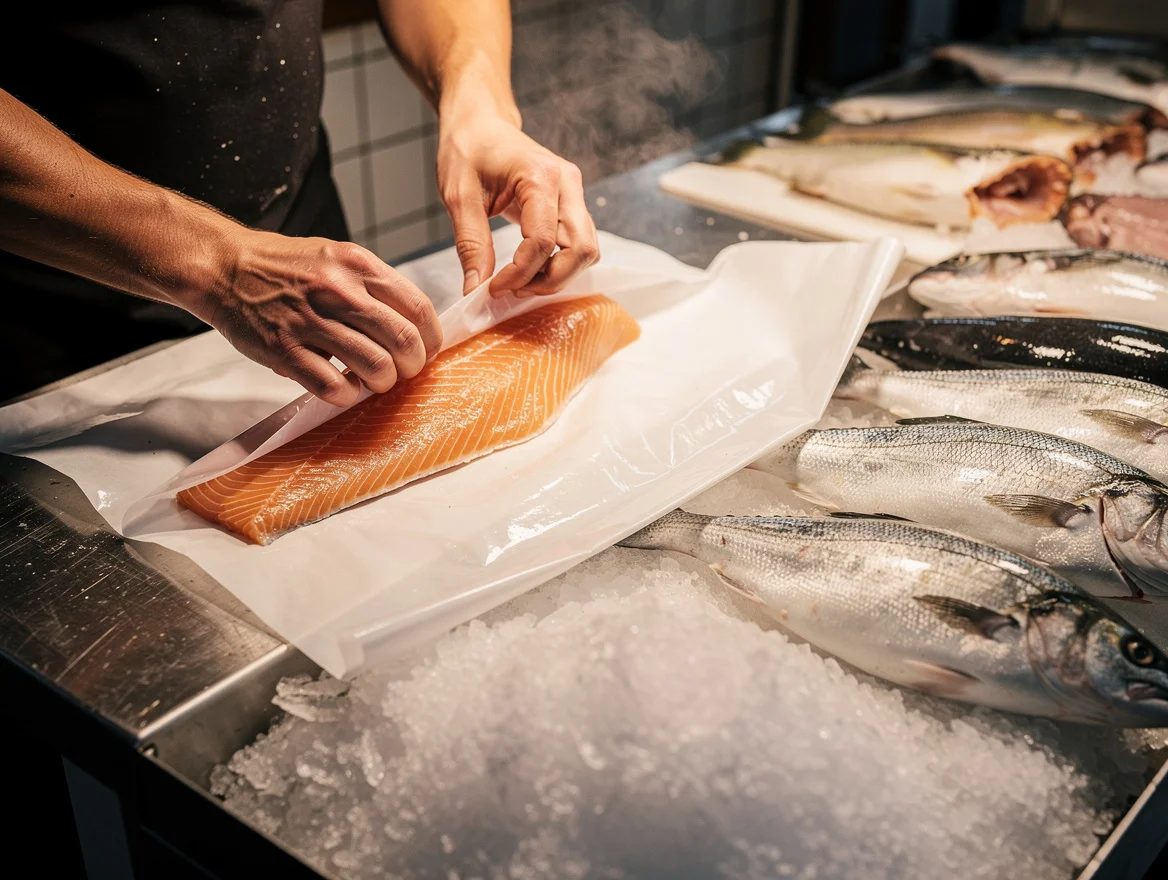
Fish and Butcher Shop Packaging: The Complete Guide to Specialty Wrapping Papers
Introduction: Why Standard Paper Fails Wet Protein Handling
Watch a busy fishmonger wrap a side of salmon or a butcher parcel a rib roast, and you're witnessing a quiet test of paper engineering. The paper must absorb surface moisture without weakening. It must resist grease penetration without becoming impermeable. It must present professionally despite handling blood, oils, and ice-melt. And it must do all this while the customer waits.
Standard kraft paper fails these tests within minutes. Blood wicks through to hands and counter surfaces. Grease creates transparent patches that signal poor hygiene to customers. Wet paper tears during wrapping, slowing service and creating waste.
Specialty converted papers solve these problems through specific treatments: wet-strength additives that maintain integrity when saturated, wax coatings that create grease barriers, and careful calibration of absorbency to manage surface moisture without creating puddles.
This guide examines the technical requirements for fish and butcher shop packaging, the paper grades available, and the practical considerations that determine which specification suits your operation.
Understanding the Challenge: What Wet Proteins Demand
Fresh fish and meat present packaging challenges that other food products don't share:
Moisture Dynamics
Surface moisture appears on all fresh proteins through:
Natural weeping from cut surfaces
Ice-melt from display and transport
Blood and plasma release
Condensation when cold product meets warmer air
The paper must absorb enough moisture to prevent pooling while retaining structural strength. Over-absorbent papers become saturated and fail; under-absorbent papers create puddles that leak or transfer to customers.
Grease and Fat Content
Different proteins release different amounts of fat:
| Protein Type | Fat/Oil Release | Grease Barrier Need |
|---|---|---|
| White fish (cod, haddock) | Low | Moderate |
| Oily fish (salmon, mackerel) | High | High |
| Lean beef cuts | Low-moderate | Moderate |
| Fatty cuts (belly, shoulder) | High | High |
| Lamb | High | High |
| Pork belly/bacon | Very high | Very high |
Blood Management
Blood creates specific challenges:
Visible staining affects customer perception
Iron content causes paper discolouration
Coagulation creates sticky residues
Blood-soaked paper weakens faster than water-soaked paper
Presentation Requirements
Customer-facing packaging must:
Conceal blood and fluid evidence
Maintain clean outer surfaces
Present professionally when handed over
Survive the journey home without failure
Paper Grades for Fish and Meat: Technical Overview

Waxed Kraft Papers
Wax-coated kraft provides the primary barrier against grease and moisture penetration.
How it works: Paraffin or microcrystalline wax is applied to kraft paper, filling pores and creating a hydrophobic barrier. The kraft base provides strength; the wax provides protection.
Typical specifications:
Base weight: 40-60gsm
Wax application: 8-15gsm
Colours: Natural brown, bleached white
Formats: Sheets, rolls, bags
Best applications:
General butcher wrapping
Fish wrapping where moderate moisture is present
Outer wrap in two-layer systems
Limitations:
Standard wax coating may crack when folded sharply
Heavily saturated conditions can eventually penetrate
Not suitable for direct contact with very oily fish for extended periods
Wet-Strength Papers
Papers treated with wet-strength resins maintain structural integrity when saturated.
How it works: Wet-strength additives (typically polyamide-epichlorohydrin or polyamide-amine-epichlorohydrin resins) create cross-links between cellulose fibres that resist water's weakening effect.
Performance comparison:
| Property | Standard Kraft | Wet-Strength Treated |
|---|---|---|
| Dry tensile strength | 100% (baseline) | 100-110% |
| Wet tensile strength | 5-10% of dry | 30-50% of dry |
| Hold time in wet conditions | Minutes | Hours |
| Recovery if dried | Poor | Good |
Best applications:
Direct fish contact where ice-melt is significant
High-moisture meat handling
Display tray liners
Extended hold time requirements
Bonewrap
Specialised paper designed for direct contact with bone-in meat cuts.
How it works: Bonewrap combines wet-strength properties with specific grease resistance and typically includes a white or coloured facing for clean presentation.
Key properties:
High wet strength to resist bone puncture
Grease resistance appropriate for meat fat
Clean release when unwrapped
Professional white presentation
Best applications:
Bone-in joints and chops
Vacuum pouch overwrap
Premium meat presentation
Carcass wrapping
Greaseproof Papers
Papers manufactured to resist grease penetration through fibre structure rather than coating.
How it works: Extended beating during manufacture creates a dense, closed fibre structure that physically resists oil penetration. No coating required for basic grease resistance.
Typical specifications:
Weight: 30-50gsm
Grease resistance: Kit rating 8-12 (higher = more resistant)
Finish: MG (machine glazed) or MF (machine finished)
Best applications:
Inner wrap for fatty meats
Fish wrapping where presentation matters
Deli counter interleaving
Food service applications
Limitations:
Grease resistance decreases over time with prolonged contact
Less moisture resistance than waxed papers
May not suit very high-fat applications
Silicone-Coated Release Papers
Papers with silicone treatment that prevents adhesion.
How it works: Silicone coating creates a non-stick surface. Products release cleanly without tearing paper fibres adhering to the product surface.
Best applications:
Interleaving between stacked items
Bacon separation
Sliced meat products
Frozen fish portions (prevents freezer-burn adhesion)
Matching Paper to Application: Decision Framework

Step 1: Identify Primary Challenge
| If Your Main Problem Is... | Prioritise... |
|---|---|
| Paper tearing when wet | Wet-strength treatment |
| Grease showing through | Waxed or greaseproof paper |
| Blood staining visible | Inner layer with absorbency + clean outer layer |
| Product sticking to paper | Silicone release coating |
| Bone puncturing packaging | Bonewrap specification |
Step 2: Consider Hold Time
How long between wrapping and customer use?
Immediate (counter service): Lower specification acceptable
30 minutes to 2 hours (prepared orders): Standard waxed kraft sufficient
2+ hours (display, delivery): Higher wet-strength and barrier specification required
Overnight/next day: Premium specification essential
Step 3: Evaluate Volume and Format
| Operation Type | Recommended Format |
|---|---|
| Low-volume specialist | Pre-cut sheets for efficiency |
| Medium-volume butcher | Sheets for precision, rolls for throughput |
| High-volume processing | Rolls with dispenser systems |
| Pre-pack operations | Custom die-cut to fit tray dimensions |
Step 4: Factor Presentation Requirements
Standard presentation: Natural kraft acceptable; focus on performance Enhanced presentation: White or coloured papers; consider print potential Premium presentation: Printed papers with branding; high-quality substrates
Two-Layer Wrapping Systems

Many operations benefit from a two-layer approach:
Inner layer: Absorbent paper in direct contact with product
Purpose: Manage surface moisture
Properties: Absorbency, food safety
Examples: Uncoated kraft, newsprint-style papers
Outer layer: Barrier paper for presentation and leak protection
Purpose: Prevent strike-through, provide clean handling surface
Properties: Wet strength, grease resistance
Examples: Waxed kraft, printed wrap
When two layers make sense:
Very wet products (freshly caught fish, ice-packed items)
High-fat products where extended contact time is expected
Premium presentation requirements where inner absorption prevents outer staining
Customer concerns about paper quality or leak potential
When single layer suffices:
Counter service with immediate handover
Lower-fat products
Cost-sensitive operations where two-layer overhead isn't justified
Food Safety Compliance
All papers used for direct food contact must meet regulatory requirements:
EU Food Contact Materials Regulation
Papers must comply with Framework Regulation (EC) No 1935/2004
Specific migration limits apply to any coatings or treatments
Traceability requirements throughout supply chain
Declaration of compliance should be available from supplier
Key Questions for Your Supplier
Is this paper certified for direct food contact?
What specific compliance documentation is available?
Are there any temperature or duration limitations?
Do any treatments affect recyclability or disposal?
Practical Compliance Steps
Request food safety certifications before specifying
Maintain supplier documentation for inspection
Train staff on proper usage and any limitations
Store paper away from contamination sources
“We switched suppliers after discovering our previous paper lacked proper food contact certification. The compliance documentation we now receive with every order gives us confidence during environmental health inspections.”- Quality Manager, Regional Butcher Chain
Operational Considerations
Storage Requirements
Paper performance depends on proper storage:
| Factor | Requirement | Why It Matters |
|---|---|---|
| Temperature | Cool, stable | Heat can migrate wax; temperature swings cause condensation |
| Humidity | Dry (<60% RH) | Moisture affects wet-strength properties and promotes mould |
| Light | Protected from direct light | UV can degrade paper properties over time |
| Contamination | Sealed storage | Paper absorbs odours; contamination affects food safety |
Staff Training Points
Correct paper selection for different products
Proper wrapping technique to maximise barrier effectiveness
Recognition of paper failure signs (saturation, grease strike-through)
Hygiene practices when handling wrapping materials
Waste Management
Consider what happens to paper post-use
Uncontaminated paper offcuts may be recyclable
Heavily soiled papers typically require general waste
Some waxed papers compost industrially; check certifications
Specification Example: Medium-Sized Fishmonger
Operation profile:
150-200 customers per day
Mix of whole fish, fillets, and prepared items
Counter service plus prepared order collection
Quality-focused positioning
Paper specification:
| Application | Paper Specified | Format | Monthly Volume |
|---|---|---|---|
| Whole fish wrap | Wet-strength waxed kraft 50gsm | 400x600mm sheets | 2,000 sheets |
| Fillet wrap | Greaseproof 40gsm | 300x400mm sheets | 3,000 sheets |
| Display tray liners | Wet-strength white | 400x300mm sheets | 1,500 sheets |
| Prepared orders | Printed waxed bags | Gusseted, branded | 800 units |
Total monthly cost: £180-220 Cost per transaction: £0.10-0.15 (approximately 0.5-1% of average transaction value)
Common Mistakes and How to Avoid Them

Mistake 1: Specifying on Price Alone
Problem: Cheapest paper fails, creating waste, rework, and customer complaints Solution: Calculate total cost including failure rate and handling time
Mistake 2: Over-Specifying for Low-Risk Products
Problem: Using premium bonewrap for white fish fillets wastes money Solution: Match specification to actual product requirements
Mistake 3: Ignoring Format Efficiency
Problem: Cutting sheets from rolls creates labour cost and waste Solution: Specify pre-cut sheets in dimensions matching your wrapping style
Mistake 4: Neglecting Storage Conditions
Problem: Paper stored poorly underperforms specification Solution: Proper storage environment; rotate stock effectively
Mistake 5: Single Specification for All Products
Problem: One paper rarely suits all products optimally Solution: Two or three specifications covering different product categories
Environmental Considerations
Paper-based fish and meat packaging has inherent sustainability advantages over plastic alternatives, but nuance matters:
Recyclability:
Uncontaminated paper offcuts: typically recyclable
Food-soiled papers: generally not recyclable (composting may be possible)
Waxed papers: varies by treatment type and local recycling facilities
PE-coated papers: limited recyclability
Certification Options:
FSC/PEFC certified paper confirms responsible forestry
Local manufacturing reduces transport emissions
Some operations specify recycled content where performance allows
Practical Balance: Primary packaging must protect food. Food waste from inadequate packaging typically has greater environmental impact than packaging material choices. Specify for performance first, then optimise sustainability within that constraint.
Conclusion: Getting Your Specification Right
Successful fish and butcher shop packaging comes down to matching paper properties to product requirements and operational realities. The key principles:
Understand your products: Different proteins demand different barrier and strength properties
Consider hold times: Longer duration requires higher specification
Calculate true costs: Include waste, rework, and customer perception alongside paper price
Test before committing: Sample papers under real conditions before volume orders
Document compliance: Maintain food safety certifications and traceability
Related Articles
Paper Packaging Solutions: Solving Real Business Challenges with Specialty Converted Paper - the pillar guide for this topic.
Luxury Cosmetics Packaging: Mould-Inhibited Paper for Brand Protection - How mould-inhibited paper protects cosmetics from damage, reduces returns, and protects brand reputation.
Industrial Anti-Corrosion VCI Papers: Complete Metal Protection Guide - VCI (vapour corrosion inhibitor) papers for metal protection - specification, ROI, and a clean alternative to oils.
Retail Brand Building with Custom Tissue Paper - Custom printed tissue for retail and e-commerce - specification, Pantone matching, design, and unboxing ROI.