
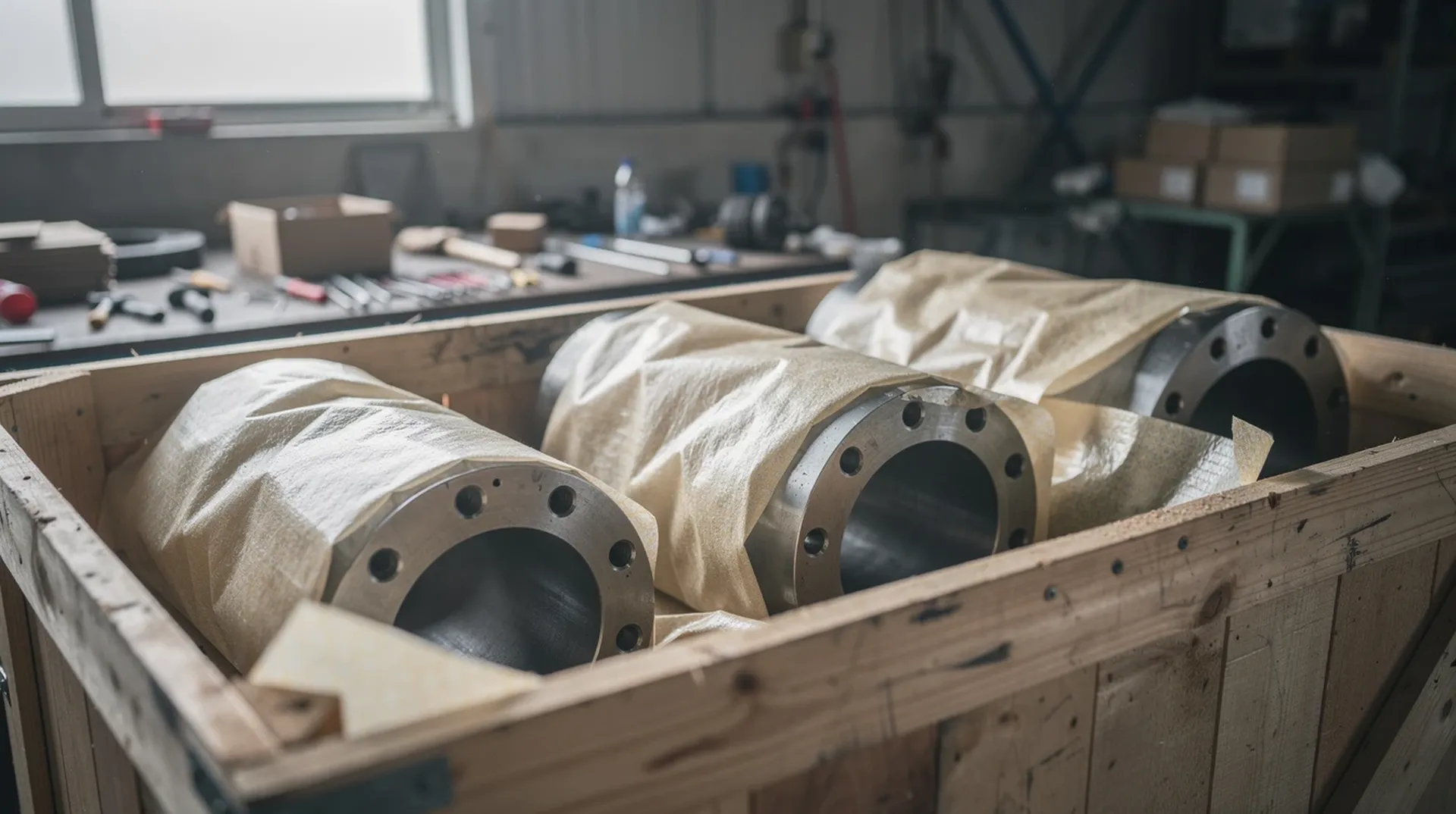
VCI Paper Buyer's Guide
If you're shipping or storing metal components and have ever opened a package to find rust where there shouldn't be any, you already know why VCI paper exists. This guide explains what VCI paper actually is, how the chemistry works, when to use it, when not to, and how to specify it for procurement.
What VCI paper actually is
VCI stands for Volatile Corrosion Inhibitor. VCI paper is kraft paper impregnated with chemical compounds that release vapours inside an enclosed package, forming a protective molecular layer on any metal surface inside the enclosure. The vapour-phase inhibitor molecules deposit on the metal in a single-molecule-thick layer that blocks moisture, oxygen and acidic gases from reaching the surface — preventing the electrochemical reactions that cause corrosion.
When the package is opened, the inhibitor dissipates harmlessly and the metal surface is left clean, dry and ready for use. There is no oily residue, no powder coating, no sticky transfer film — components can typically be moved directly into assembly or end-use without any cleaning step.
How VCI works — the chemistry

The active inhibitor compounds in VCI paper are organic chemicals with two specific properties:
Volatility — they slowly vaporise at room temperature, releasing molecules into the air space within an enclosure
Adsorption affinity for metal — the molecules preferentially adsorb to metal surfaces, forming an oriented monolayer
Common inhibitor chemistries include:
Dicyclohexylamine nitrate (DICHAN) — historical reference inhibitor, effective on ferrous metals
Cyclohexylamine carbonate — improved volatility profile, broader pH stability
Proprietary multi-metal blends — combinations of organic amines, nitrites and azoles tuned for specific metals
Newer "green" formulations — bio-derived inhibitors with reduced REACH and toxicity concerns
The inhibitor is held within the kraft paper fibres in a stable solid state until the paper is enclosed in a defined air space. Inside the enclosure the inhibitor establishes an equilibrium vapour pressure, which is low enough to be invisible and odourless but high enough to maintain protection.
When VCI paper is the right answer

VCI paper is the standard solution where:
Metal components are shipped or stored for weeks to months
Components must be clean and immediately usable on unwrapping (no cleaning step)
Multiple components share a package — VCI protects all metal in the enclosure, not just direct contact
Cost-effectiveness matters — VCI is dramatically cheaper than oils and far cleaner than oil residue removal
Environmental compliance is required — REACH-compliant VCI inhibitors are the cleaner alternative to oil-based protection
Common applications:
Automotive components and spare parts
Aerospace fasteners and machined parts
Industrial bearings, gears, machined assemblies
Electronic enclosures with ferrous internal components
Defence equipment in long-term storage
Marine engineering components in transit
Tool steel and precision machined product
When VCI is not the right answer
Open-air storage — the inhibitor concentration can't be maintained outside an enclosure
Very long-term storage in humid environments — beyond about 24 months in standard application
Direct contact with non-metal materials sensitive to amines — some plastics and elastomers can be affected by amine vapours
Food-contact applications — VCI inhibitors are not food-safe
Components needing visual surface inspection during storage — the inhibitor coats the surface (invisibly) but you can't easily test it
Ferrous vs multi-metal VCI — what's the difference?
This is the question we get asked most often. The short answer:
Ferrous-only VCI is engineered for steel and cast iron. The chemistry is optimised for these metals at the lowest cost
Multi-metal VCI adds protection for copper, brass (up to 20% zinc content), bronze and most non-ferrous metals
Specialist VCI (aluminium, magnesium, specific exotic alloys) requires custom formulation
If your components are exclusively steel/cast iron, ferrous-only VCI is the cheaper and equally effective specification.
If your shipment contains any non-ferrous metal — copper bus bars, brass fittings, bronze bushings, aluminium fasteners — use multi-metal VCI. Ferrous-only chemistry is not protective for non-ferrous metals. In fact, some ferrous-only inhibitors can actually accelerate corrosion of certain non-ferrous metals via galvanic effects.
When in doubt: multi-metal. The cost premium over ferrous-only is small (~10-20%) and you remove an entire category of in-service failure.
Choosing VCI paper specifications

Six questions, in order of importance:
1. What metal(s) are being protected?
| Metal | VCI Type |
|---|---|
| Steel, cast iron only | Ferrous VCI paper |
| Mixed ferrous + copper, brass, bronze | Multi-metal VCI paper |
| Aluminium-dominant assemblies | Specialist multi-metal formulation |
| Galvanised, plated or coated metals | Multi-metal — some plating coatings react with ferrous-only |
| Uncertain mix | Multi-metal (safer default) |
2. How long is the storage / transit period?
| Duration | Specification |
|---|---|
| <6 months indoor | 50 gsm standard kraft VCI |
| 6–12 months indoor | 50–60 gsm VCI in sealed enclosure |
| 12–24 months indoor | 60 gsm VCI + barrier-quality enclosure |
| 24–36 months | Waxed VCI kraft + foil-barrier overwrap |
| 36+ months | Multi-layer VCI laminate (specialist spec) |
3. What's the storage environment?
Climate-controlled warehouse — standard kraft VCI is fine
Unheated warehouse or shed — ensure enclosure quality is high
Outdoor storage / shipping container — waxed VCI + barrier overwrap; control humidity ingress
Ocean shipping — waxed VCI + sealed barrier bag, higher gsm where component is heavy
4. What's the component handling pattern?
Wrap each component individually — pre-cut sheets sized to the component
Interleave between layers in a crate — large sheets, often custom-cut to crate footprint
Wrap reels or long product — reel form, slit to width
High-volume automated packing — reel form integrated with packing line
Bone-in / sharp-edged components — die-cut shapes specifically engineered against puncture
5. What enclosure is the VCI paper inside?
VCI works only in an enclosure that maintains inhibitor vapour concentration. Acceptable enclosures:
Vacuum-formed plastic clamshells (good)
Cardboard boxes with internal poly-bag (good)
Foil-laminate barrier bags (excellent)
Sealed wooden crates with poly liner (good for medium-term)
Open shipping pallets (poor — VCI ineffective)
Open shelving (poor)
6. What's the volume?
Volume affects MOQ and pricing band. From-stock standard VCI paper has no minimum at our facility. Custom-spec VCI (different gsm, custom inhibitor, die-cut shapes) starts at 1 tonne.
Common VCI procurement mistakes
Assuming VCI works in open storage — it doesn't. Without an enclosure, inhibitor vapour disperses too quickly to maintain protection
Using ferrous VCI on non-ferrous metals — protection isn't there and some inhibitors accelerate non-ferrous corrosion
Specifying VCI without considering enclosure — the paper alone isn't a system; the package is the protection unit
Buying the cheapest VCI without checking storage duration claim — generic VCI marketed as "long term protection" may be 6 months; specialist multi-layer can do 36+ months
Forgetting REACH compliance for European customers — older VCI chemistries (sodium nitrite-amine) are restricted in some EU jurisdictions; verify before specifying for EU export
Specifying VCI paper — the procurement template
For a clean RFQ to a UK paper converter, provide:
| Spec field | Example |
|---|---|
| Metal type(s) | "Steel + brass + bronze components" |
| Component dimensions | "150–400mm parts, irregular shapes" |
| Annual volume | "12,000 components/year, ~50,000 wraps" |
| Storage / transit duration | "Up to 18 months sea freight + warehouse" |
| Storage environment | "Container ship + UK distribution warehouse" |
| Enclosure | "Cardboard outer box with internal poly liner" |
| Format preference | "Pre-cut sheets ~300×400mm + reel for long items" |
| Current method | "Currently using rust-prevent oil — switching due to cleaning costs" |
| Compliance | "REACH compliant for EU export; standard UK food-adjacent warehousing" |
Provide all nine and any UK paper converter can deliver an accurate quote.
ROI calculation — VCI vs oil
For a typical mixed-metal component manufacturer shipping 10,000 parts annually with current rust-prevent oil method:
| Cost component | Oil method | VCI paper method | Saving |
|---|---|---|---|
| Material cost (£/yr) | £30,000 (£3/m² × 10,000m²) | £6,000 (£0.60/m² × 10,000m²) | £24,000 |
| Application labour (£/yr) | £15,000 | £5,000 | £10,000 |
| Cleaning before use (£/yr, customer-borne) | £55,000 (£5.50/part × 10,000) | £0 | (customer goodwill) |
| Hazardous waste disposal | £8,000 | £0 (paper recyclable) | £8,000 |
| **Annual direct saving** | **£42,000** | ||
| Plus reduced complaints, warranty claims, returns | (significant) |
Numbers vary by component value, complexity and customer requirements. Run the calc against your specific case before deciding.
Sustainability profile

VCI paper has a strong sustainability profile relative to alternatives:
EPR fees — kraft paper substrate falls into the lower paper banding (£15–45/tonne)
Recyclability — uncoated VCI kraft is recyclable in standard UK paper streams (the inhibitor compounds dissipate and don't contaminate pulp); waxed VCI variants are more complex
Alternative to chemical-heavy oils — reduces hazardous waste generation
Lower carbon footprint per unit — paper-based, no oil chemistry
REACH-compliant chemistry — modern VCI inhibitors meet REACH restrictions
For supply chain sustainability reporting, VCI paper typically scores well as a corrosion protection method.
Where to source UK VCI paper
UK manufacture of VCI paper is concentrated in a handful of converters. The advantages of UK manufacture:
Overnight reach — Grantham (where we are) is on the A1 with reach to most of UK in 24-48 hours, vs weeks from European or Asian imports
Custom format — sheets, reels and die-cut shapes from one supplier without import logistics
Direct technical support — questions about a specific application get answered by the converter, not a distributor
Compliance documentation — UK-issued declarations of compliance, REACH evidence, certificates of analysis
We carry standard ferrous and multi-metal VCI in stock for fast turnaround, and run custom production for specialist specifications. See our VCI paper range for current stock grades.
Bottom line
VCI paper is the standard cost-effective solution for protecting metal components in shipping and storage. Specify by metal type, duration, environment and enclosure rather than just "VCI paper, please." For most mixed-metal applications, multi-metal VCI is the safer default. For ferrous-only operations, ferrous-only VCI saves cost.
The most expensive mistake in this category isn't choosing the wrong VCI grade — it's failing to switch from rust-prevent oils when the economics clearly favour VCI.
Browse our VCI paper range Talk to our spec team