
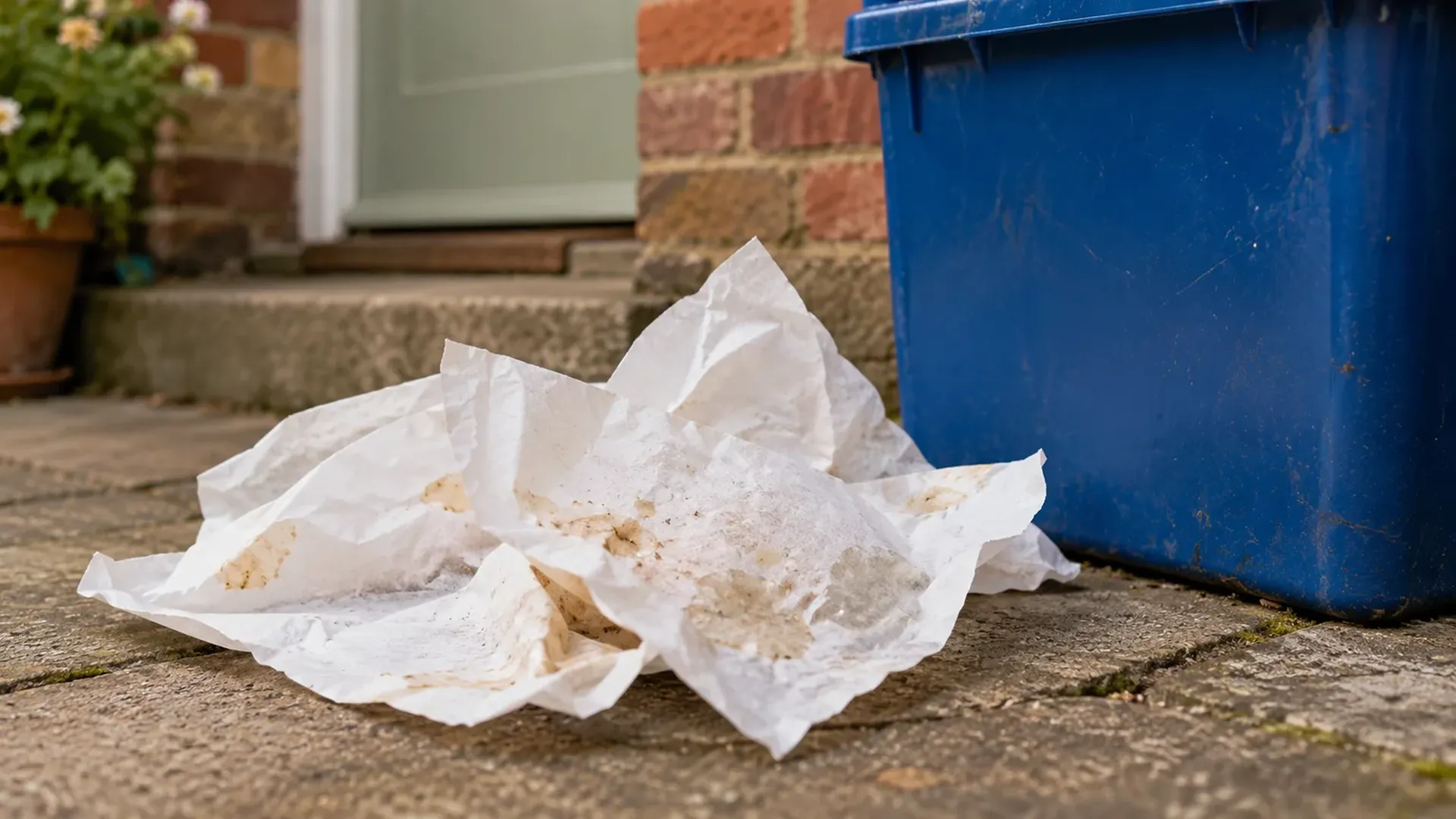
Is greaseproof paper recyclable in the UK?

The material is; the used sheet often is not collected.
Uncoated greaseproof paper is made only of wood pulp fibre, beaten until it forms a dense sheet. There is no wax, silicone or plastic layer to separate, so a mill can pulp it like other paper. That is why product specifications, including ours, describe it as recyclable in paper streams.
Household collection is a different question. Many councils ask residents not to put greaseproof paper in the recycling. Cornwall Council's recycling guidance, for example, says greaseproof paper "is not collected as part of your recycling collection" and should go in the general waste bin. There are two practical reasons:
Food contamination. A burger wrap or butcher sheet carries fat and food residue, which spoils paper bales.
It looks like coated paper. Neither householders nor sorting lines can easily tell uncoated greaseproof from silicone baking paper or waxed paper, so councils give one simple instruction for all of them.
For a business this splits into two answers. Clean production waste, such as offcuts, trim and unused stock, is recyclable paper and is uncoated paper fibre, so ask your waste contractor whether it will take it in the business paper stream. Used, food-soiled wrap that reaches your customers will, in most areas, end up in general waste or food waste.
Can you put greaseproof paper in the compost bin?
Yes, if it is uncoated. Plain greaseproof paper is plant fibre and breaks down in a compost heap along with the food on it. Some councils also accept soiled paper with food waste; check the local rules before telling customers they can.
A "compostable" claim on packaging is a stronger statement. In the UK and EU it normally means certification to EN 13432, the standard for industrial composting. Certification applies to a specific grade and, where the paper is printed, to the printed result. Ask us which grades carry certification for your application.
Is greaseproof paper biodegradable?
Yes. Uncoated greaseproof is cellulose fibre, which biodegrades. "Biodegradable" on its own is a weak claim, though, because it says nothing about how long the material takes or under what conditions. If you want to make an environmental claim on pack, "compostable" backed by EN 13432 certification or "plastic-free" are clearer. Our guide to biodegradability covers the terms in more depth.
Does greaseproof paper contain plastic?
Plain greaseproof paper does not. It resists grease through the density of its fibres, not through a plastic film or coating. That is the main difference between greaseproof and some lookalike papers:
PE-coated paper has a thin polyethylene layer for a moisture barrier. It does contain plastic. We supply it for butchers who need that barrier (PE-coated butcher paper), but it should never be described as plastic-free.
Waxed paper carries a wax coating. Paraffin wax is petroleum-derived but it is not a plastic film.
Grease-resistant papers treated with fluorochemicals contain no plastic layer but may contain PFAS. See our guide to PFAS in food paper.
If a supplier's specification lists a coating or a laminate, ask what it is before you call the wrap plastic-free.
Why is parchment paper not recyclable?
Parchment, or baking paper, has a silicone coating on one or both sides. Silicone does not break down in the pulping process and has to be screened out, and used baking paper usually has food baked onto it. Most councils therefore ask for it to go in general waste. Our guide to greaseproof vs parchment paper explains the difference between the two papers in full.
Is waxed paper recyclable?
Not through most household collections. The wax coating has to be separated from the fibre, which needs a mill set up for it, and used waxed paper is usually food-soiled. Whether any route exists for used waxed paper depends on your waste contractor and the mill they supply, so ask them before you tell customers it can be recycled. Our page on wax coatings sets out the trade-off between barrier performance and end of life.
Food paper recyclability at a glance

| Paper | Plastic layer | Kerbside recycling in most areas | Composting |
|---|---|---|---|
| Plain greaseproof | No | Often refused when used; clean paper is repulpable | Breaks down; certification depends on the grade |
| Printed greaseproof, water-based inks | No | As plain greaseproof | As plain greaseproof; ask us which printed grades are certified |
| Silicone baking paper | No, silicone coating | Usually refused | Not usually certified |
| Waxed paper | No, wax coating | Usually refused | Not usually certified |
| PE-coated paper | Yes | Refused | No |
What are two types of paper that can't be recycled?
The two most common are food-soiled paper and coated paper. Grease and food residue spoil paper bales, which is why used takeaway wraps, chip papers and pizza box bases are often refused. Coatings such as silicone, wax and polyethylene have to be separated from the fibre, so baking paper, waxed paper and PE-coated paper are usually excluded from kerbside collections.
What a UK food business must record for packaging EPR

Under UK extended producer responsibility for packaging (EPR), obligated businesses report the packaging they supply each year, and large producers pay fees based on it. GOV.UK's guidance "Check if you must comply with EPR for packaging" says you are obligated if you carry out a packaging activity, are established in the UK, supplied or imported more than 25 tonnes of packaging in the previous year and have worldwide annual turnover of £1 million or more. It defines a large producer as one with turnover above £2 million that supplies more than 50 tonnes. Our EPR compliance guide walks through them.
For greaseproof wrap, the records that matter are:
Your role. GOV.UK lists the packaging activities that make a business a producer, such as supplying filled packaging under your own brand, packing or filling, importing, supplying unfilled packaging you manufacture or import, and selling filled packaging to an end user. Who reports depends on how the wrap is supplied; check the GOV.UK producer responsibility guidance for your case.
Material and weight. Paper and card, in kilograms. Weight per sheet multiplied by quantity supplied is the usual method; your supplier should be able to give you the weight per unit.
Packaging type. GOV.UK's guidance "Check what to report for EPR for packaging as a large producer" asks you to say whether packaging is household or non-household, commonly ends up in public bins, is a drink container, is reusable or is self-managed. That guidance lists packaging given to consumers with takeaway food, including wraps and paper, as packaging that commonly ends up in public bins.
Recyclability assessment. GOV.UK's Recyclability Assessment Methodology (RAM) guidance says large producers must assess household packaging and packaging that commonly ends up in public bins, and rate it red, amber or green. PackUK's modulated disposal fees policy statement says household packaging fees are modulated on recyclability from 2026 to 2029. Record the coating and any laminate for each wrap so you can assess it.
Keep the supplier's specification sheet with your records. A plain greaseproof wrap and a PE-coated one look the same in a stock list but are classified differently.
What can you claim on the pack?
The Competition and Markets Authority's Green Claims Code, published on GOV.UK, says environmental claims must be truthful and accurate, clear and unambiguous, must not omit or hide important information and must be substantiated. For greaseproof wrap that means:
"Plastic-free" can be accurate where the specification shows no plastic coating or laminate. Check the grade before you use it.
"Compostable" needs certification, normally EN 13432, for the exact grade and print.
"Recyclable" on its own risks misleading customers if their council will not collect used wrap. If you use it, say what it applies to.
Working with GMLUK
GMLUK buys greaseproof base paper from mills and converts and prints it in Grantham, Lincolnshire, using water-based, food-safe inks. Ask us for the weight per unit and material data for the specification you are considering, which is what your EPR return needs. FSC-certified base paper is available. Minimum orders depend on grade and print; most plain and printed greaseproof starts at 10,000 sheets or the reel equivalent, with lead times from 3 weeks. Ask for a quote below that, or about combining with another order.
See greaseproof paper, estimate the effect of switching with our sustainability calculator, request free samples or get a quote.
Frequently asked questions
Is greaseproof paper recyclable?
Plain greaseproof paper is pure paper fibre with no plastic or wax, so a mill can repulp it. In practice, many UK councils ask households to put used greaseproof paper in general waste, because it is usually food-soiled and hard to tell apart from coated baking paper. Clean offcuts and unused stock are uncoated paper, so ask your waste contractor about business paper recycling.
Is greaseproof paper recyclable in the UK?
It depends on the council and on how clean the paper is. Cornwall Council, for example, says greaseproof paper is not collected in household recycling and should go in general waste. Clean, uncoated greaseproof is recyclable paper fibre. Used wraps with food on them usually belong in general waste or, where the council accepts it, food waste.
Can you put greaseproof paper in the compost bin?
Yes, if it is uncoated. Plain greaseproof paper is plant fibre and breaks down in a compost heap, food residue included. Silicone baking paper and waxed paper are not suitable for home compost. For packaging sold as compostable, look for certification to EN 13432, the industrial composting standard.
Does greaseproof paper contain plastic?
Plain greaseproof paper does not. It resists grease because its fibres are beaten into a dense sheet, not because of a plastic layer. PE-coated papers do contain a thin polyethylene film, and some grease-resistant papers have been treated with fluorochemicals. Check the specification for any coating or laminate before calling a wrap plastic-free.
Why is parchment paper not recyclable?
Parchment, or baking paper, has a silicone coating that does not break down when paper is pulped, and used sheets are usually covered in baked-on food. Most UK councils therefore ask for baking paper to go in general waste. Uncoated greaseproof paper does not have this coating.
Is parchment paper compostable?
Silicone-coated parchment is not normally certified compostable, and most councils treat it as general waste. Uncoated greaseproof paper is the better choice where composting matters. For packaging sold as compostable, look for certification to EN 13432 for the exact grade, and ask your supplier which of their grades carry it. Home compost rules vary, so check locally.
Can waxed paper be recycled?
Not through most household collections. The wax coating must be separated from the paper fibre, which needs a mill set up for it, and used waxed paper is usually food-soiled. If recyclability is the deciding factor, plain greaseproof is the simpler choice; if you need a moisture barrier, waxed paper does that job better.
What do I need to record for EPR on greaseproof wrap?
If your business is obligated under UK packaging EPR, GOV.UK's guidance asks for the packaging activity you carry out, the material and weight supplied, and the packaging type, such as whether it commonly ends up in public bins. Large producers also assess recyclability. Who reports depends on how the wrap is supplied. Ask your supplier for the weight per unit and specification.