
Retail Brand Building with Custom Tissue Paper: Creating Unboxing Experiences That Drive Loyalty
Introduction: The Moment That Shapes Perception
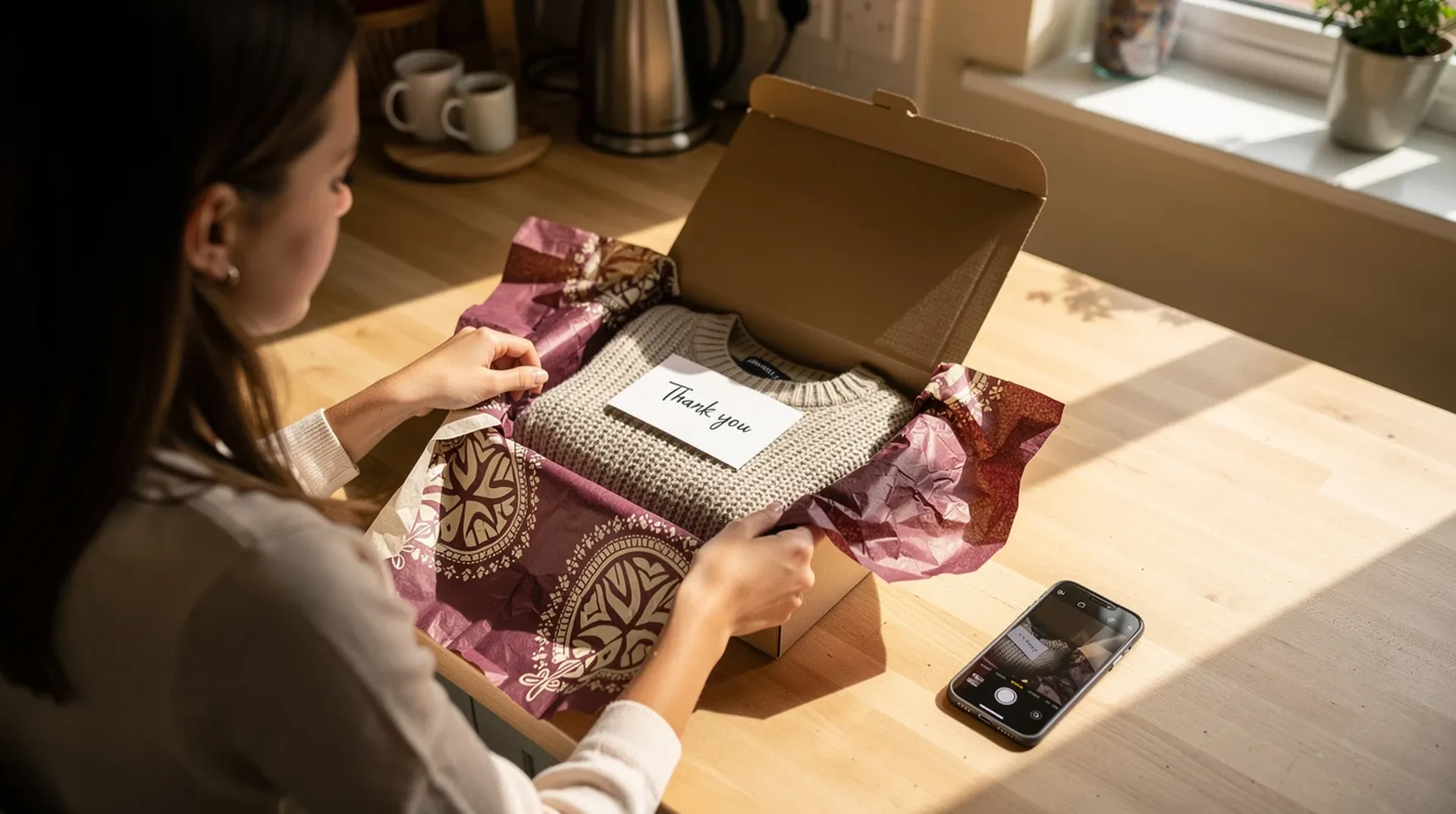
The package arrives. The customer opens the outer box and encounters tissue paper-printed with your colours, your pattern, perhaps your logo. Before they've even seen the product, an impression has formed: this brand pays attention to details. This brand cares about the experience.
That moment-mundane in execution, meaningful in impact-represents one of the highest-ROI brand touchpoints available to retailers. Custom tissue paper costs pennies per parcel but shapes the perception of products worth tens or hundreds of pounds.
In an e-commerce landscape where physical retail touchpoints have diminished, packaging has become the primary tangible expression of brand. The unboxing moment is, for many customers, their only physical interaction with your brand between purchase decision and product use.
This guide examines how retailers and e-commerce businesses use custom tissue paper strategically, the specification options available, design considerations, and how to calculate return on investment for branded packaging.
The Business Case for Branded Tissue Paper
The Unboxing Phenomenon
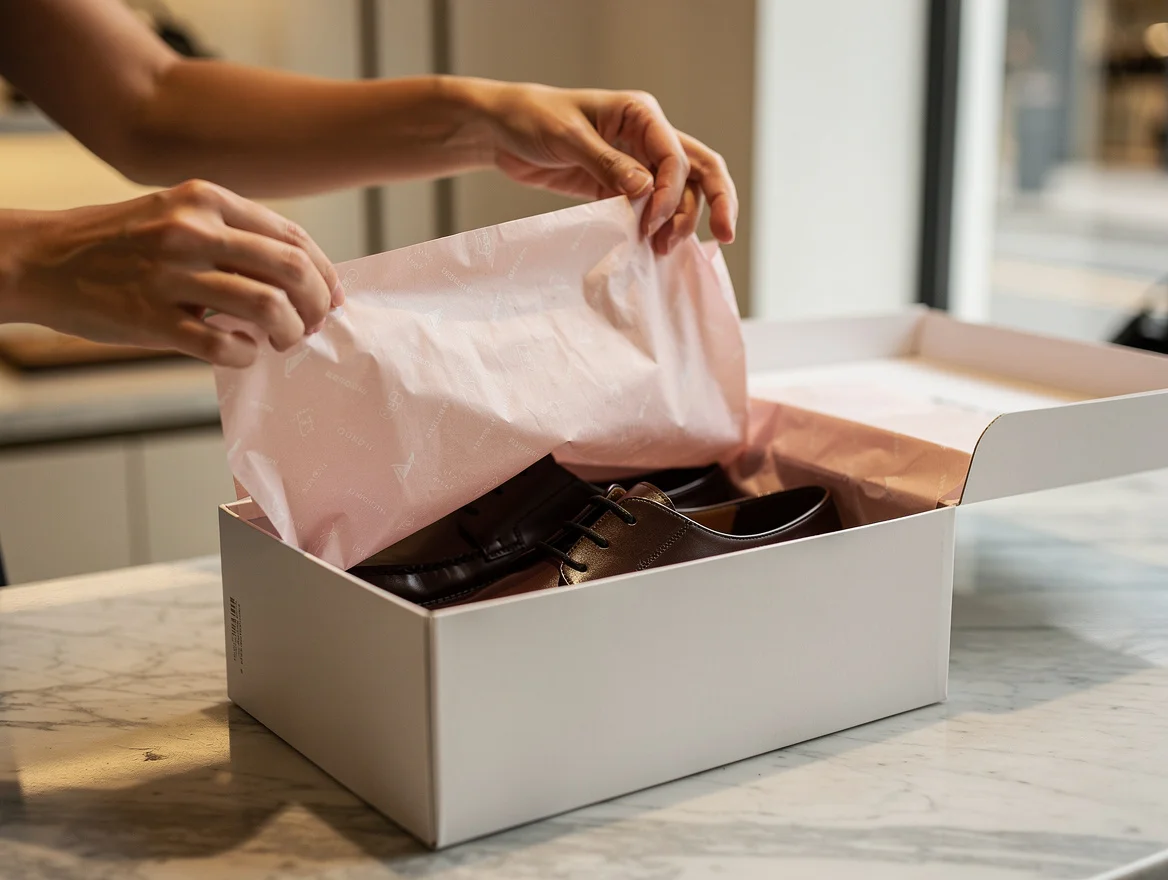
Social media has transformed packaging from operational necessity to marketing channel. Consider the scale:
#unboxing has generated billions of views across platforms
40% of online shoppers share packaging experiences on social media
Premium packaging correlates with repeat purchase intent
Branded tissue appears prominently in customer photography
Perception Premium
Custom tissue paper creates perceived value disproportionate to its cost:
| Packaging Element | Cost per Parcel | Perceived Value Impact |
|---|---|---|
| Plain brown box | £0.15-0.30 | Neutral/negative |
| Branded outer box | £0.80-2.50 | Positive |
| Custom tissue paper | £0.08-0.25 | Highly positive |
| Combined premium packaging | £1.50-3.50 | Significantly positive |
The tissue paper specifically signals attention to detail that customers attribute to overall brand quality.
Competitive Differentiation
In categories where products are similar, packaging becomes a differentiator:
Scenario: Customer orders comparable products from two retailers. Retailer A ships in plain packaging. Retailer B wraps in custom tissue with a printed thank-you card. Which does the customer remember? Which builds loyalty?
Premium packaging creates switching costs through emotional attachment-customers feel like Retailer B's customers in a way they don't with Retailer A.
Understanding Tissue Paper Options
Paper Grades
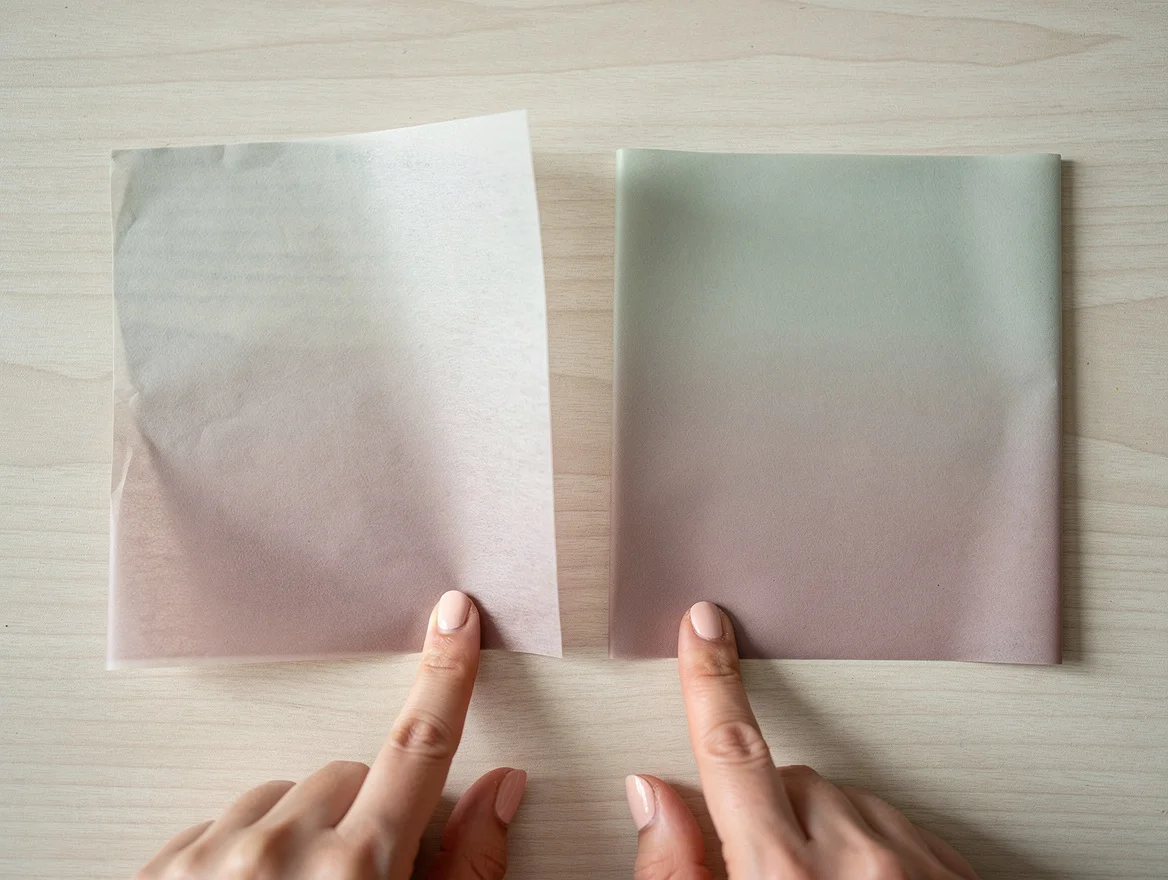
Two primary tissue grades serve retail packaging:
MF Tissue (Machine Finished) - 17gsm:
Lightweight, translucent
Soft hand feel
Elegant appearance
Best for: Lightweight products, fashion, jewellery, cosmetics
Consideration: May require multiple sheets for adequate coverage
MG Tissue (Machine Glazed) - 21gsm:
Slightly heavier, more opaque
One-side smooth surface
More substantial feel
Best for: Products benefiting from weightier presentation, items requiring more protection
Consideration: Higher cost per sheet than MF
Comparative characteristics:
| Property | MF Tissue (17gsm) | MG Tissue (21gsm) |
|---|---|---|
| Weight | Lighter | Heavier |
| Opacity | Lower | Higher |
| Stiffness | Softer | Slightly crisper |
| Print surface | Good | Very good (glazed side) |
| Perceived quality | Elegant/delicate | Premium/substantial |
| Cost | Lower | Higher |
Print Options
Random-cut designs:
Print pattern applied continuously
Sheets cut without registration to pattern
Lower cost due to simplified production
Pattern appears differently positioned on each sheet
Best for: All-over patterns, abstract designs, budget-conscious operations
Registered designs:
Print elements positioned precisely on each sheet
Logos centred, borders aligned
Higher cost due to precision requirements
Consistent presentation
Best for: Logo-focused designs, formal presentations, luxury positioning
Coverage options:
| Coverage Type | Description | Cost Impact | Best Application |
|---|---|---|---|
| Spot print | Single colour, limited coverage | Lowest | Simple branding, high volume |
| Multi-colour spot | Multiple colours, limited coverage | Moderate | Sophisticated branding |
| Full coverage | 100% print coverage | Higher | Maximum brand impact |
| Full bleed | Edge-to-edge colour | Highest | Luxury positioning |
Colour Matching
Pantone specification: Professional brands require exact colour reproduction. Pantone (PMS) colour specification ensures:
Consistent colour across production runs
Matching with other brand materials
Reproducible results over time
Process colour (CMYK): Four-colour process printing offers flexibility but less exact colour control. Appropriate for:
Photographic elements
Gradient designs
Lower-cost alternatives to Pantone
Design Considerations

Pattern vs. Logo Approaches
Logo-centric designs:
Repeated logo placement across tissue
Clear brand identification
Strong recognition in photography
Risk: Can appear commercial rather than premium if overdone
Pattern-based designs:
Brand colours and aesthetic without explicit logos
Sophisticated, less overtly commercial
Creates brand association through colour/style
Risk: Less immediately identifiable as "your" brand
Hybrid approaches:
Patterns incorporating subtle logo elements
Colour-based designs with occasional logo placement
Balance between recognition and sophistication
Seasonal and Campaign Flexibility
Consider how tissue paper fits your planning cycles:
Year-round core design:
Single design serving most parcels
Higher volume, lower unit cost
Consistent brand presentation
Limitation: Less seasonal relevance
Seasonal variants:
Holiday-specific designs (Christmas, Valentine's, etc.)
Requires inventory management for multiple SKUs
Higher unit costs for smaller runs
Benefit: Timely, relevant presentation
Campaign-specific:
Limited editions for launches or promotions
Creates urgency and collectibility
Highest unit cost
Best for: Major launches, premium positioning
Design Mistakes to Avoid
Over-complicated patterns: Intricate designs may not reproduce well at tissue paper weights. Test samples before committing.
Colour combinations that don't photograph: Consider how tissue appears in customer photos-some colour combinations look muddy or indistinct on camera.
Ignoring the crumple test: Tissue paper will be crumpled, smoothed, and repositioned. Designs that only work when flat miss the reality of use.
Logo scale issues: Logos too small lose impact; too large appear overwhelming. Test at intended print size on actual tissue.
Forgetting the product context: Tissue should complement, not compete with, the product it reveals. Bright, busy tissue may overwhelm delicate products.
“We initially designed very logo-heavy tissue-our brand name repeated in a grid pattern. Customer feedback was that it felt 'cheap' despite the custom printing. A subtle tone-on-tone pattern in our brand colours tested much better for perceived quality.”- Brand Director, Fashion Accessories Retailer
Specification Process
Step 1: Define Objectives
What do you want the tissue to achieve?
| Objective | Design Implication | Grade Choice |
|---|---|---|
| Brand recognition | Logo visibility important | Either, higher coverage |
| Premium perception | Subtle sophistication | MG tissue, refined design |
| Social media impact | Photographable, distinctive | Bold colours, clear pattern |
| Product protection | Physical function | MG tissue, multiple sheets |
| Sustainability message | Material choice signals values | FSC certified, recycled content |
Step 2: Determine Practical Parameters
Sheet size: Match to your typical parcel interior dimensions. Standard sizes offer cost efficiency; custom sizes may better suit specific applications.
Quantity requirements:
What is your monthly/annual parcel volume?
How many sheets per parcel?
What inventory space do you have?
How does minimum order quantity affect your economics?
Usage rate: Calculate consumption to inform ordering: ``` Monthly parcels × sheets per parcel = monthly sheet usage Monthly usage × 12 = annual requirement Annual requirement + 10% buffer = order planning figure ```
Step 3: Request Samples and Quotes
Sample requests should specify:
Paper grade (MF or MG)
Sheet dimensions
Print approach (colours, coverage)
Design files (or request design support)
Quote comparisons should include:
Unit cost at various quantities
Setup/plate costs for initial order
Repeat order costs (no new setup)
Delivery timeline
Minimum order quantities
Step 4: Test Before Committing
Before volume orders:
Test samples in actual packaging workflow
Evaluate appearance with real products
Photograph under typical conditions
Get staff feedback on handling
Consider customer response (focus group or soft launch)
Operational Integration
Packaging Workflow
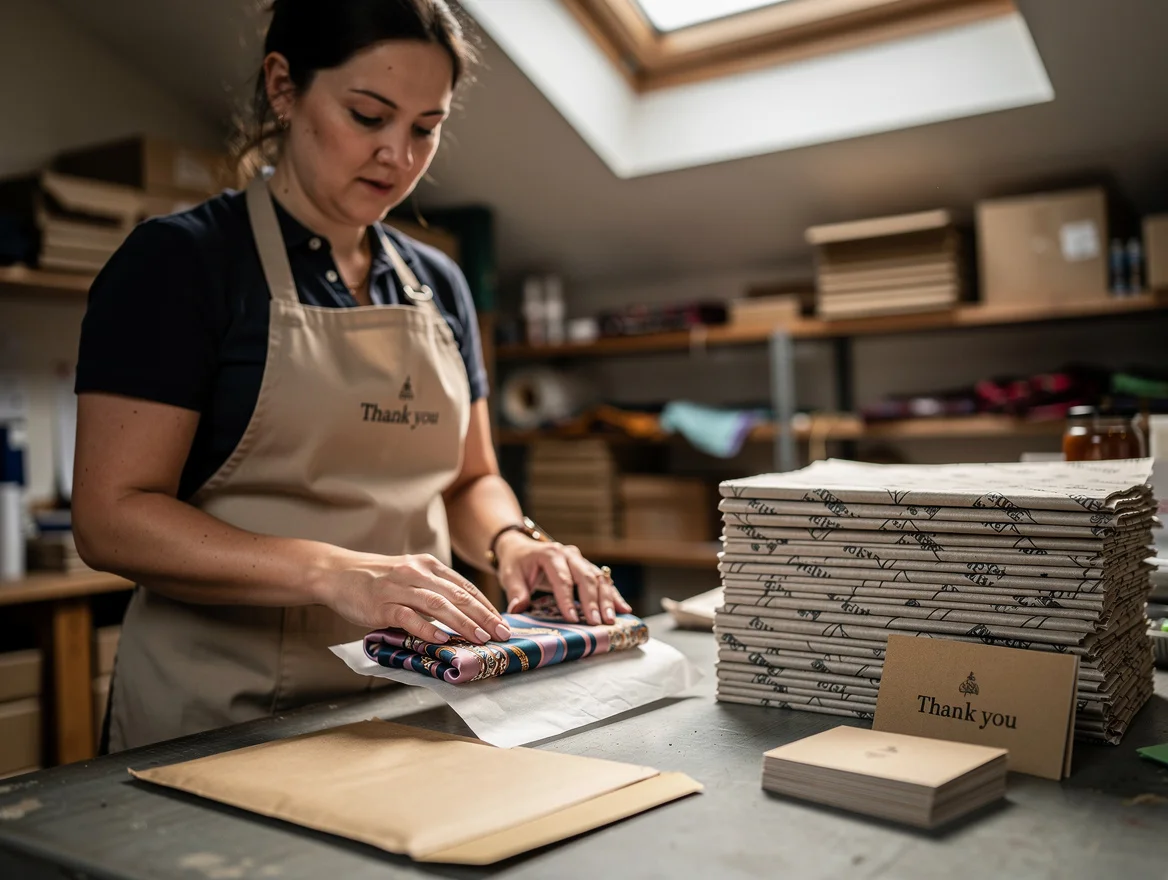
Tissue paper should enhance, not complicate, fulfilment operations:
Single-sheet approach:
One tissue sheet per parcel
Fastest handling
Lower material cost
Suitable for: Small items, streamlined operations
Nest wrapping:
Product placed on tissue, edges folded over
Moderate handling time
Good product protection and reveal
Suitable for: Most applications
Full wrap:
Product fully wrapped in tissue before boxing
Highest handling time
Maximum protection and presentation
Suitable for: Premium products, fragile items
Crinkle fill alternative:
Shredded tissue creates volume and cushioning
Can be pre-prepared or shredded on-site
Different aesthetic-playful rather than refined
Suitable for: Casual brands, gift-oriented products
Staff Training Considerations
Consistent presentation requires training:
How many sheets per parcel?
What orientation? (Design visible when opening)
Folding technique if applicable
Quality standard for tissue condition (tears, stains)
Photography documentation if gathering content
Inventory Management
Storage requirements:
Dry conditions (humidity damages paper)
Flat storage or proper reel handling
Away from contamination sources
FIFO rotation for print consistency
Reorder triggers:
Set reorder point based on lead time and usage rate
Account for seasonal volume variation
Build buffer for delivery delays
ROI Calculation Framework
Cost Components
Direct costs:
Tissue paper unit cost × quantity
Delivery costs
Storage costs
Additional handling time (valued at labour rate)
Example calculation: ``` Monthly parcels: 5,000 Sheets per parcel: 1.5 (average) Sheet cost: £0.12 Monthly tissue cost: 5,000 × 1.5 × £0.12 = £900 Additional handling: 10 seconds × £15/hour = £0.04/parcel = £200 Total monthly cost: £1,100 Cost per parcel: £0.22 ```
Value Attribution
Measuring tissue paper's specific contribution is difficult-it operates within a packaging system. However, consider:
Trackable metrics:
Change in repeat purchase rate (before/after implementation)
Change in referral rate
Customer satisfaction scores mentioning packaging
Social media mentions and user-generated content volume
Review content referencing packaging
Attributed value example: ``` If branded tissue contributes to:
5% improvement in repeat purchase rate
Average customer lifetime value: £200
Monthly new customers: 1,000
Attributed value: 1,000 × 5% × £200 = £10,000/month
vs. tissue cost of £1,100/month = significant positive ROI ```
Competitive Context
Consider the cost of not doing it:
If competitors use premium packaging and you don't, how does that affect consideration?
What is the cost of appearing "cheaper" than alternatives?
How do customer expectations in your category influence necessity?
Beyond Tissue: Complete Packaging Experience
Tissue paper works best as part of a coherent system:
Complementary Elements
| Element | Function | Integration with Tissue |
|---|---|---|
| Outer packaging | Protection, first impression | Sets up tissue reveal |
| Stickers/tape | Branding, security | Colour/design coordination |
| Thank-you cards | Personal connection | Same brand language |
| Product tags | Information, decoration | Design consistency |
| Samples/gifts | Surprise, value-add | Wrapped or presented with tissue |
Design System Thinking
Develop a packaging design system rather than isolated elements:
Consistent colour palette across materials
Coordinated but not identical patterns
Typography consistency
Production efficiency through shared elements
Sustainability Messaging
If sustainability matters to your brand and customers:
Communicate paper sourcing (FSC, recycled content)
Consider compostable or recyclable options
Avoid mixed-material elements that complicate recycling
Authenticity: ensure claims are accurate and verifiable
“We redesigned our entire packaging system when introducing custom tissue. The tissue forced us to think about every element coherently. It improved everything-even our fulfilment efficiency-because we had a clear standard.”- Operations Manager, Online Gift Retailer
Common Questions
What are typical minimum order quantities?
MOQs vary by supplier and specification. For custom printed tissue, expect minimums of 5,000-10,000 sheets minimum, with better unit economics at higher volumes.
How long does custom tissue production take?
Allow 3-4 weeks for custom printed tissue, longer for new designs requiring plate production. Repeat orders with existing plates are typically faster.
Can I print on both sides?
Single-side printing is standard for tissue paper. Double-sided printing is possible but significantly increases cost and may affect paper properties.
Will tissue paper damage products?
Uncoated tissue is generally safe for most products. For sensitive surfaces (high-polish metals, certain plastics), test compatibility. Acidic papers can affect some materials over time-specify acid-free for archival applications.
What about sustainable options?
FSC-certified tissue confirms responsible forestry. Recycled content tissue is available but may affect brightness and print quality. Verify claims meet your standards and communicate authentically to customers.
Conclusion: Investment in Experience
Custom tissue paper represents a small cost with disproportionate impact. In a retail environment where physical touchpoints are increasingly limited to the delivery experience, packaging is marketing-and tissue paper is a highly efficient brand-building tool.
Key takeaways:
Match specification to positioning: Premium brands need premium execution; casual brands can be more flexible
Design for reality: Tissue will be crumpled, photographed, and viewed in context with products
Calculate true ROI: Include customer lifetime value impacts, not just immediate costs
Integrate systematically: Tissue works best within a coherent packaging design system
Test before committing: Sample under real conditions before volume orders
Related Articles
Paper Packaging Solutions: Solving Real Business Challenges with Specialty Converted Paper - the pillar guide for this topic.
Fish and Butcher Shop Packaging: The Complete Guide to Specialty Wrapping Papers - Specialty wrapping papers for wet protein - wet-strength, bonewrap, greaseproof, waxed kraft.
Luxury Cosmetics Packaging: Mould-Inhibited Paper for Brand Protection - How mould-inhibited paper protects cosmetics from damage, reduces returns, and protects brand reputation.
Industrial Anti-Corrosion VCI Papers: Complete Metal Protection Guide - VCI (vapour corrosion inhibitor) papers for metal protection - specification, ROI, and a clean alternative to oils.
Frequently asked questions
Can you get custom tissue paper printed?
Yes. Custom tissue paper is printed with your logo, pattern or brand colours before it is packed. As a UK paper converter we print tissue on our own presses, from a single-colour logo to full-coverage designs, so the unboxing carries your brand from the first fold.
Can you print on tissue paper with a regular printer?
Not reliably. Tissue is thin and porous, so home and office printers jam and the ink bleeds. Branded tissue is produced on commercial presses built for lightweight paper, which hold registration and colour across thousands of sheets. For any repeatable or on-brand result, professional printing is the route.
How much does custom printed tissue paper cost?
It is quoted per order, not sold at a fixed sheet price. Cost depends on sheet size, the number of print colours and coverage, and quantity, plus a one-off origination charge for the print plate. The per-sheet rate then falls as volume rises. Send your spec for a quick quote.
What is the minimum order for custom tissue paper?
The minimum is set by total paper weight, not a fixed number of sheets, so it shifts with your sheet size: smaller sheets mean more sheets per order, larger sheets fewer. Rather than a headline figure, send your size and quantity and we will confirm the practical minimum.
Is printed tissue paper food safe?
It can be. For bakeries, delis and food brands we print tissue on food-contact-compliant paper with food-safe inks. Tell us the application when you enquire and we will specify the right grade.
What sizes and weights does printed tissue paper come in?
Tissue is commonly supplied around 17 to 22 gsm, in MF (soft, everyday) or MG (one glossy side, more premium) finishes, cut to your parcel size. We convert and print to your dimensions rather than forcing standard sheets, so the tissue fits your box and your brand.