
Beyond Recycling: Designing Paper Packaging for Circular Economy Compliance
Introduction: Recycling Isn't Circular Economy
Most packaging conversations use "recyclable" and "circular economy" interchangeably. They're not the same.
Recyclable means theoretically capable of being recycled. Circular economy means designed to actually be recycled, repeatedly, maintaining material value across multiple cycles.
The distinction matters legally (UK's 2024 EPR regulations penalize non-circular design) and environmentally (recyclable materials that aren't recycled provide zero benefit).
This article provides the framework for designing paper packaging that participates in true circular economy-not just theoretically recyclable products that end up in landfill.
Section 1: Circular Economy Fundamentals for Packaging
The Nine R's Framework
Moving beyond the traditional "3 Rs" (reduce, reuse, recycle), circular economy employs a hierarchy:
For Paper Packaging:
Refuse: Eliminate unnecessary packaging (most relevant for transit packaging)
Rethink: Design for multi-use or alternative delivery models
Reduce: Minimize material usage while maintaining protection
Reuse: Enable container reuse (limited for paper but emerging)
Recycle: Design for effective recycling (our focus)
Recover: Energy recovery as last resort
Most paper packaging focuses on positions 3 and 5-reduction and recycling. But circular economy thinking pushes toward positions 1-3.
Material Quality Retention
True circular economy maintains material value across cycles:
Paper Fiber Degradation:
Each recycling cycle shortens cellulose fibers by ~20%
Typical fiber can sustain 5-7 recycling cycles before too short for paper-making
After 5-7 cycles, downcycled to cardboard, then insulation, then compost
Design Implication: Circular design must consider not just "is it recyclable" but "what quality paper can this become?"
Section 2: UK EPR Regulations - The Economic Driver

How EPR Changed the Economics
Before EPR: Packaging disposal was customer's problem After EPR (2024): Producers pay fees based on material type and recyclability
EPR Fee Structure (2024 rates):
| Material | Base Fee | Recyclability Multiplier | Effective Range |
|---|---|---|---|
| Plastic (recyclable) | £750/tonne | 0.8-1.2x | £600-900/tonne |
| Plastic (non-recyclable) | £750/tonne | 3.0x | £2,250/tonne |
| Paper (recyclable) | £35/tonne | 0.6-1.0x | £21-35/tonne |
| Paper (non-recyclable) | £35/tonne | 2.0x | £70/tonne |
| Aluminum | £850/tonne | 0.8x | £680/tonne |
Recyclability Assessment Criteria
EPR recyclability classification considers:
1. Material Compatibility (40% weight)
Is base material accepted by UK reprocessors?
Do coatings/adhesives/inks survive recycling process?
2. Sorting Feasibility (25% weight)
Can material be effectively sorted in MRFs (Material Recovery Facilities)?
Does contamination prevent identification?
3. Contamination Risk (25% weight)
Does food contact prevent recycling?
Do residues contaminate recycling streams?
4. Market Demand (10% weight)
Do mills want this recycled material?
Is there economic incentive to recycle?
Assessment Process:
Submit packaging specifications to EPR scheme
Receive recyclability classification (typically 4-6 weeks)
Classification determines fee modulation
Annual re-assessment if design changes
Section 3: Design Principles for Recycling Optimization

Principle 1: Minimize Coating Coverage
Coatings are necessary for functionality but complicate recycling:
Best Practices:
Strategic Coating Placement:
Apply coatings only where functionally necessary
Interior moisture barriers, not full exterior coverage
Spot UV or aqueous coating instead of flood coating
Example: Fish wrap traditionally has full wax coating. By optimizing to 70% coverage (leaving uncoated edges), we improved recyclability classification from "moderate" to "high" without compromising moisture protection.
Coating Type Selection:
Preferred: Aqueous dispersions, starch-based coatings (easily separate in pulping)
Acceptable: Wax coatings (many UK mills can process)
Problematic: Silicone release coatings (contaminate recycling)
Avoid: PE or plastic laminations (create mixed-material waste)
Principle 2: Water-Based Inks Only
Solvent-based and UV-curable inks create recycling challenges:
Migration in Recycling: UV inks don't fully deink, creating:
Specks in recycled paper
Chemical contamination
Quality degradation requiring downcycling
Recommended Ink Systems:
Water-based flexographic inks (our standard)
Low-migration formulations for food contact
Mineral pigments over organic dyes
Principle 3: Avoid Mixed Materials
Common Circular Economy Killers:
Paper + Plastic Windows: Greeting cards, food bags with visibility windows
Solution: Eliminate window or use cellophane (plant-based, though has own issues)
Paper + Foil Laminations: Barrier packaging
Solution: Improve paper barrier properties through coating or accept performance trade-off
Paper + Plastic Clips/Ties: Bagged products
Solution: Paper-based closure systems or redesign for no closure
Excessive Tape or Stickers: Labels that don't release in pulping
Solution: Water-based adhesives, minimize label coverage
Real-World Redesign Example: Customer supplied bread bags with plastic window showing product. Recycling classification: "non-recyclable mixed material" (£70/tonne EPR fee).
Redesigned with full paper construction and printed "brand name" where window was. Maintains shelf visibility through printing, achieves "highly recyclable" classification (£21/tonne EPR fee).
Cost impact: £49/tonne EPR savings, minimal design cost. ROI: 6 months.
Principle 4: Design for Contamination Tolerance
Food-contact packaging will have food residue. Design must assume this:
Strategies:
1. Grease-Resistant Papers
Kit test level 10+ greaseproof grades
Resists absorption, allowing residue removal in pulping
Enables recycling of contaminated packaging
2. Moisture Barriers That Release
Wax coatings that float off in pulping
Avoid coatings that bind permanently to fiber
3. Single-Substrate Construction
If all components are the same base material, contamination is less destructive
Example: All-kraft construction vs. bleached paper with kraft reinforcement
Section 4: MRF (Material Recovery Facility) Compatibility
Understanding the Sorting Process
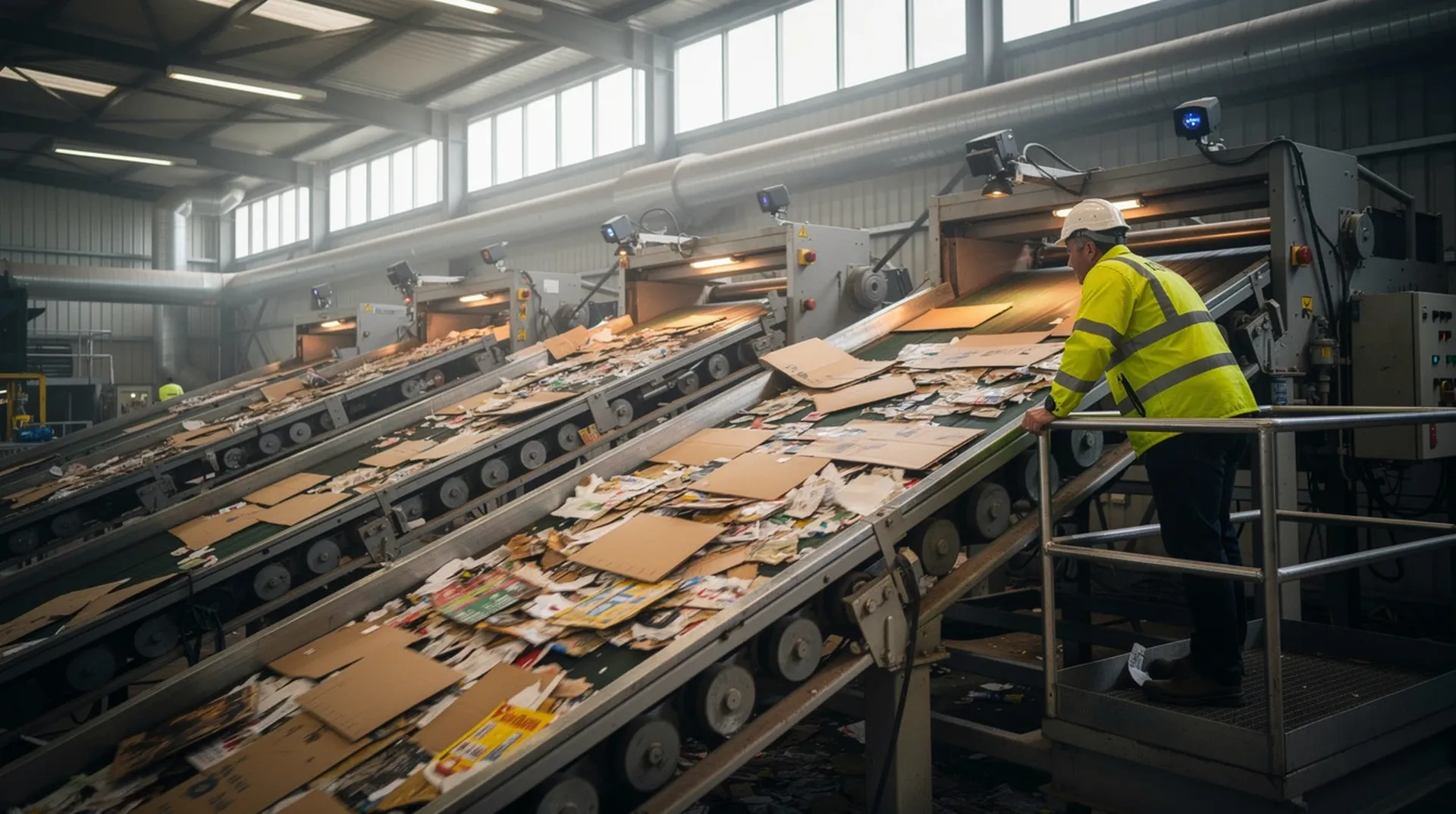
Most paper packaging passes through MRFs before reaching mills:
Typical MRF Process:
Bag Breaking: Opens refuse bags
Pre-Sort: Manual removal of large contaminants
Screening: Size separation (removes fines)
Optical Sorting: Near-infrared (NIR) identification
Air Classification: Separates light paper from heavy containers
Manual QC: Final contamination removal
Baling: Compression for transport
Design for MRF Success:
Size Matters:
Too small: Falls through screens (lost to residual waste)
Too light: Blows into wrong stream in air classifier
Optimal: >A5 size, >40gsm weight
Optical Sorting Compatibility:
NIR recognizes material by spectral signature
Dark colors or metallic inks confuse systems
Avoid: Black paper, metallic printing, holographic finishes
Contamination Flags:
Food residue triggers manual removal if excessive
Strong odors (fish, garlic) cause entire bales to be rejected
Liquid contamination destroys bale value
Contamination Tolerance Thresholds
UK paper mills have contamination tolerances:
Acceptable Contamination Levels:
Food residue: <2% by weight (grease-resistant papers tolerate more)
Plastic contamination: <0.5%
Metal contaminants: <0.1%
Other paper grades: <5%
Exceed these and entire bales are rejected (sent to landfill or incineration).
Section 5: Quality Cascading and Downcycling

Understanding Material Value Retention
Not all recycling maintains material value equally:
Paper Quality Cascade:
Cycle 1-2: High-grade paper High-grade paper
Minimal fiber degradation
Maintains strength and brightness
Example: Office paper Office paper
Cycle 3-4: High-grade paper Mid-grade paper
Noticeable fiber shortening
Reduced brightness, strength
Example: Food packaging Cardboard boxes
Cycle 5-6: Mid-grade paper Low-grade paper/board
Significant fiber degradation
Structural uses only
Example: Cardboard Insulation, egg cartons
Cycle 7+: Downcycling to non-paper
Fiber too short for paper making
Composting or energy recovery only
Design Implication: Paper packaging should target maximum quality retention. This means:
Minimize contamination (preserves fiber quality)
Use recyclable coatings (enables clean fiber recovery)
Design for effective sorting (prevents mixing with lower-grade streams)
The "Design for Next Use" Principle
Ask: "What product will this become after recycling?"
High-Value Recycling (Maintain in Food-Grade Cycle):
Minimal ink coverage
Water-based inks only
No excessive coating
Results in: Food-contact paper Food-contact paper
Mid-Value Recycling (Acceptable Downcycling):
Moderate ink coverage
Wax or aqueous coatings
Some contamination tolerance
Results in: Food packaging Cardboard, paperboard
Low-Value Recycling (Significant Downcycling):
Heavy printing
Multiple coatings
High contamination
Results in: Packaging Insulation, animal bedding
Section 6: Practical Implementation Guide
Step-by-Step Circular Design Process
Phase 1: Function Analysis (Week 1)
List all functional requirements (moisture barrier, grease resistance, etc.)
Identify minimum performance thresholds
Question whether each requirement is genuine (often specifications are over-engineered)
Phase 2: Material Selection (Week 1-2)
Select base paper with recycled content where possible (maintains circular demand)
Choose recyclability-optimized coating types
Specify water-based inks with low-migration properties
Phase 3: Design Optimization (Week 2-3)
Minimize coating coverage
Reduce printing coverage where possible
Eliminate mixed materials
Design for standardized sizing (improves MRF sorting)
Phase 4: Testing (Week 3-6)
Functional testing: Does it perform?
Recyclability testing: Does it process successfully?
Contamination tolerance: Does it recycle after use?
Phase 5: EPR Assessment (Week 6-10)
Submit specifications to EPR scheme
Receive recyclability classification
Optimize design if necessary
Lock in specification
Investment Required:
Testing: £2,000-5,000
EPR assessment: £500-1,500
Design iterations: 20-40 hours technical time
Total: £5,000-10,000 for major product development
ROI Calculation:
EPR fee savings: £10-50/tonne
Customer preference premium: 5-10%
Payback period: Typically 12-24 months
Working with Converters on Circular Design
Questions to Ask Your Converter:
Experience:
How many products have you optimized for EPR?
What's your recyclability success rate?
Testing Capabilities:
Do you conduct recyclability testing in-house?
Which mills do you partner with for validation?
EPR Support:
Do you provide EPR classification support?
Will you manage EPR reporting on our behalf?
Supply Chain:
What recycled content options do you offer?
Are your materials FSC/PEFC certified?
Innovation:
What alternative coating technologies are you developing?
Can you provide circular economy consultation?
Section 7: Industry Initiatives and Standards
OPRL (On-Pack Recycling Label)
UK's consumer-facing recycling labeling system:
Label Types:
Widely Recycled: >75% of UK councils collect for recycling
Check Locally: 20-75% of councils collect
Not Yet Recycled: <20% of councils collect
Application to Paper Packaging:
Most paper packaging qualifies for "Widely Recycled"
Food-contaminated may require "Check Locally"
Mixed materials typically "Not Yet Recycled"
Compliance:
Mandatory for >75% of large companies (2024 regulations)
Requires evidence-based assessment
Annual review necessary
CEPI (Confederation of European Paper Industries) Guidelines
4evergreen Initiative: Focus areas:
Increase recycling rates
Improve circularity
Enhance recyclability
Increase use of recycled fibers
We follow 4evergreen design guidelines including:
Minimum 95% fiber content
Compatible adhesives and coatings
Avoid contaminants that damage recycling
Section 8: Common Circular Economy Mistakes
Mistake 1: Assuming Recyclable = Recycled
Problem: Material theoretically recyclable but no collection/sorting/reprocessing infrastructure
Example: Compostable packaging marked recyclable (contaminates recycling stream)
Solution: Design for actual UK recycling infrastructure, not theoretical possibility
Mistake 2: Over-Engineering Barriers
Problem: Specifying high-performance coatings when moderate performance sufficient
Example: Silicone coating on sandwich wrap when wax would suffice
Solution: Performance threshold testing to establish minimum requirements
Mistake 3: Ignoring Post-Consumer Reality
Problem: Designs that work in clean conditions fail with real-world contamination
Example: Aqueous coating that breaks down when exposed to food acids
Solution: Contamination tolerance testing with actual use conditions
Mistake 4: Mixed Messaging
Problem: Claiming "sustainable" or "eco-friendly" without specifying circular pathway
Example: "Biodegradable" paper sent to landfill (doesn't biodegrade in anaerobic conditions)
Solution: Clear disposal instructions aligned with actual end-of-life pathway
Conclusion: Building True Circularity
Circular economy for paper packaging isn't complex, but it requires discipline:
Design for actual recycling infrastructure, not theoretical recyclability
Minimize coatings and mixed materials
Test for contamination tolerance
Obtain EPR classification
Communicate clearly to consumers
As a converter, we're committed to circular principles:
85% of our products achieve "highly recyclable" or "recyclable" EPR classification
We conduct recyclability testing for all new product developments
We partner with UK mills to validate real-world recycling success
We provide EPR support to all customers
The future of packaging is circular. The question is whether your designs will participate or be left behind.
Related Articles
Sustainable Paper Packaging: From Material Sourcing to End-of-Life - the pillar guide for this topic.
Biodegradability vs. Compostability: What Food Businesses Need to Know - Biodegradable vs compostable - critical differences, EN 13432 standards, coating impact, UK infrastructure reality.
The Hidden Carbon Footprint of Paper Packaging - Honest carbon analysis from pulp to delivery - and why UK manufacturing cuts emissions 40-55% vs imported alternatives.
Wax Coatings and Release Agents: Performance vs. Environmental Responsibility - Compare wax and release coatings - paraffin, PE, soy wax, beeswax, silicone - performance, cost, sustainability trade-offs.