
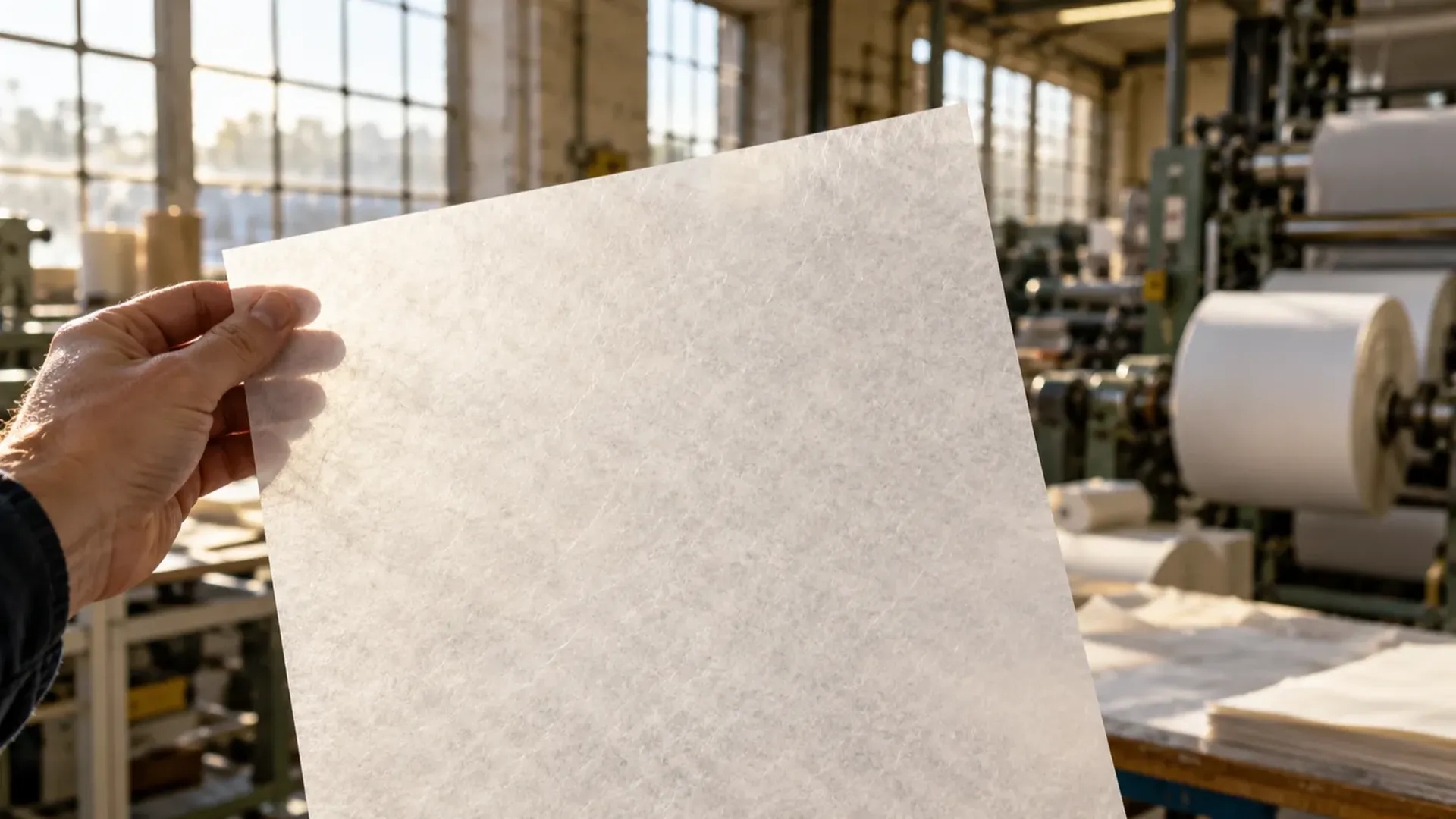
What is greaseproof paper made from?
Wood pulp, and nothing else in its basic form. Most greaseproof paper uses bleached chemical pulp from softwood and hardwood trees. FSC-certified base paper is available.
What makes it greaseproof is not an ingredient but a process. Ordinary paper has an open network of fibres with air gaps between them, which is why oil soaks straight through a paper towel. In greaseproof paper the fibres are packed so tightly that there are almost no gaps for oil to travel along.
How is greaseproof paper made?

Greaseproof paper is made by specialist mills. The steps that matter are:
Pulping. Wood chips are cooked to separate the cellulose fibres, then washed and usually bleached.
Beating, also called refining. This is the defining step. The pulp is beaten between metal bars for much longer than for ordinary paper. The fibres absorb water, swell and fray into fine fibrils, which makes them flexible and gives them far more surface to bond with.
Forming. The beaten pulp is spread on the paper machine's wire. Because the fibres are so fine and swollen, water drains slowly and the fibres lie down in a close, dense web.
Pressing and drying. As the water leaves, the fibres bond tightly to each other. The result is a strong sheet with very low porosity.
Calendering. Many grades are pressed between smooth rollers to make the surface denser and smoother. Pressing it much harder gives glassine, the translucent, glossy paper used for soap wrap and bakery bags.
Historically some grease-resistant papers were treated with fluorochemicals. That is a different route to grease resistance, and our guide to PFAS in food paper explains why buyers now ask about it.
Who makes greaseproof paper, and what does a converter do?

Mills make the base paper in large reels. A converter buys those reels and turns them into products a food business can use. GMLUK is a converter: we buy greaseproof base paper from mills and, in Grantham, we:
sheet it to your dimensions,
slit it into reels from 50 mm to 1,000 mm wide on 51 or 76 mm cores,
die-cut discs, rings and shapes up to 500 mm,
print it in up to 6 colours by flexography with water-based, food-safe inks,
make it into flat and gusseted counter bags.
For a buyer, the practical point is that the base paper fixes the grease resistance and weight, and the converter fixes the size, format, print and pack count. Our paper converting guide covers each process.
Greaseproof paper grades and GSM
GSM (grams per square metre) is the paper's weight. Heavier paper is stronger and more opaque; lighter paper is cheaper per sheet and folds more easily.
| Weight | Typical use |
|---|---|
| 38 gsm (standard) | General-purpose sheets, interleaving and printed branded wrap |
| Heavier weights, on request | Burger and sandwich wrap, where wet strength under hot food matters |
We supply 38 gsm as standard, with other weights on request.
Grease resistance is specified separately from weight. The usual measure is the kit test (TAPPI T 559), which drops a series of oil and solvent mixtures on the paper and records the strongest one it resists, on a scale of 1 to 12. A higher kit number means more grease resistance. Our greaseproof burger wrap is rated kit 7. If a supplier quotes "greaseproof" without a kit number, ask for one.
Other properties worth putting on a specification: brightness (our standard grade is 80 to 85 ISO), whether the paper is bleached, and the food-contact declaration. Our guide to material selection helps match these to the job.
What is greaseproof paper used for?

In kitchens, greaseproof paper is used to line cake tins (greased first, because it is not non-stick), wrap food and cover dishes. In the food trade the uses are wider:
burger, sandwich and deli wraps,
fish and chip paper and takeaway wraps,
tray and basket liners,
interleaving sliced meat, cheese and patties (interleaving paper),
bakery bags and counter bags,
branded, printed wrap for food brands (printed greaseproof paper),
non-food separators where grease or oil must not transfer.
What is parchment paper made of?
Two different products share the name.
Silicone baking parchment, what UK shops sell as baking paper, is a dense paper coated with silicone, usually on both sides. The silicone makes it non-stick and suited to oven use. This is what most people mean by parchment paper today.
Vegetable parchment is paper passed through a bath of sulphuric acid, which partly dissolves the surface fibres and fuses them into a smooth, tough layer. It resists grease and water and keeps its strength when wet. It has a long history in butter wrapping; see is parchment paper the same as butter paper?.
Neither is made from animal skin. The name comes from the look of traditional parchment.
What is baking paper made of?
In the UK, baking paper is the same as silicone baking parchment: a paper base with a silicone coating. Greaseproof paper has no coating, which is the key difference. Our guide to greaseproof vs parchment paper compares the two for oven use and trade jobs.
Is greaseproof paper safe for food?
Yes, when it is made and converted for food contact. In the UK, food-contact materials must comply with Regulation (EC) 1935/2004 as retained in UK law, which requires that they do not transfer substances to food in amounts that could harm health. We supply our greaseproof products compliant with that regulation and print with inks that comply with the EuPIA exclusion list. Our food contact compliance guide explains what to ask a supplier for.
Working with GMLUK
GMLUK has converted and printed paper in Grantham, Lincolnshire since 1967. We buy greaseproof base paper from mills and sheet, slit, die-cut, print and bag it to your specification. Minimum orders depend on grade and print. Most plain and printed greaseproof starts at 10,000 sheets or the reel equivalent, with lead times from 3 weeks. Ask for a quote below that, including combining with another order or a short run.
See greaseproof paper, request free samples to feel the grades, or get a quote.
Frequently asked questions
What is greaseproof paper made from?
Greaseproof paper is made from wood pulp. The fibres are beaten for much longer than for ordinary paper, so they swell, fray and bond into a dense sheet with very few pores. Oil and fat cannot pass through, so the paper resists grease without any wax, silicone or plastic coating.
What is greaseproof paper?
Greaseproof paper is a dense, uncoated paper that stops oil and fat soaking through. Its grease resistance comes from the way the fibres are beaten and packed together at the mill, not from a coating. It is used to wrap food, line tins and trays, interleave sliced products and make printed branded wrap.
What is greaseproof paper for in cooking?
In cooking, greaseproof paper lines cake tins and baking trays, wraps food and covers dishes. It is not non-stick, so recipes ask you to grease it before baking. In food businesses it is mainly used for wrapping burgers, sandwiches and deli items, lining trays and interleaving sliced meat or cheese.
What is parchment paper made of?
Baking parchment, sold in the UK as baking paper, is paper coated with silicone, usually on both sides, which makes it non-stick and oven-safe. Vegetable parchment is a different product: paper treated with sulphuric acid so its surface fuses into a tough, grease-resistant layer. Neither is made from animal skin.
What is baking paper made of?
Baking paper is a paper base coated with silicone. The silicone gives a non-stick surface that releases bakes cleanly and copes with oven heat. Greaseproof paper looks similar but has no coating, so it is not non-stick and needs greasing before baking.
Which brands of parchment paper are PFAS free?
We cannot speak for retail brands. For trade buying, ask the supplier for a written statement that no PFAS are intentionally added, and for the basis of that statement. Our greaseproof resists grease through the paper's structure, not a fluorochemical coating. Ask us for the mill's PFAS declaration for the grade you are buying.
What GSM is greaseproof paper?
Food greaseproof paper is commonly supplied at 38 gsm as standard, with other weights available on request. Heavier paper is stronger and more opaque, while lighter paper is cheaper per sheet and folds more easily. Grease resistance is specified separately, usually as a kit rating under TAPPI T 559, so ask for both figures.