
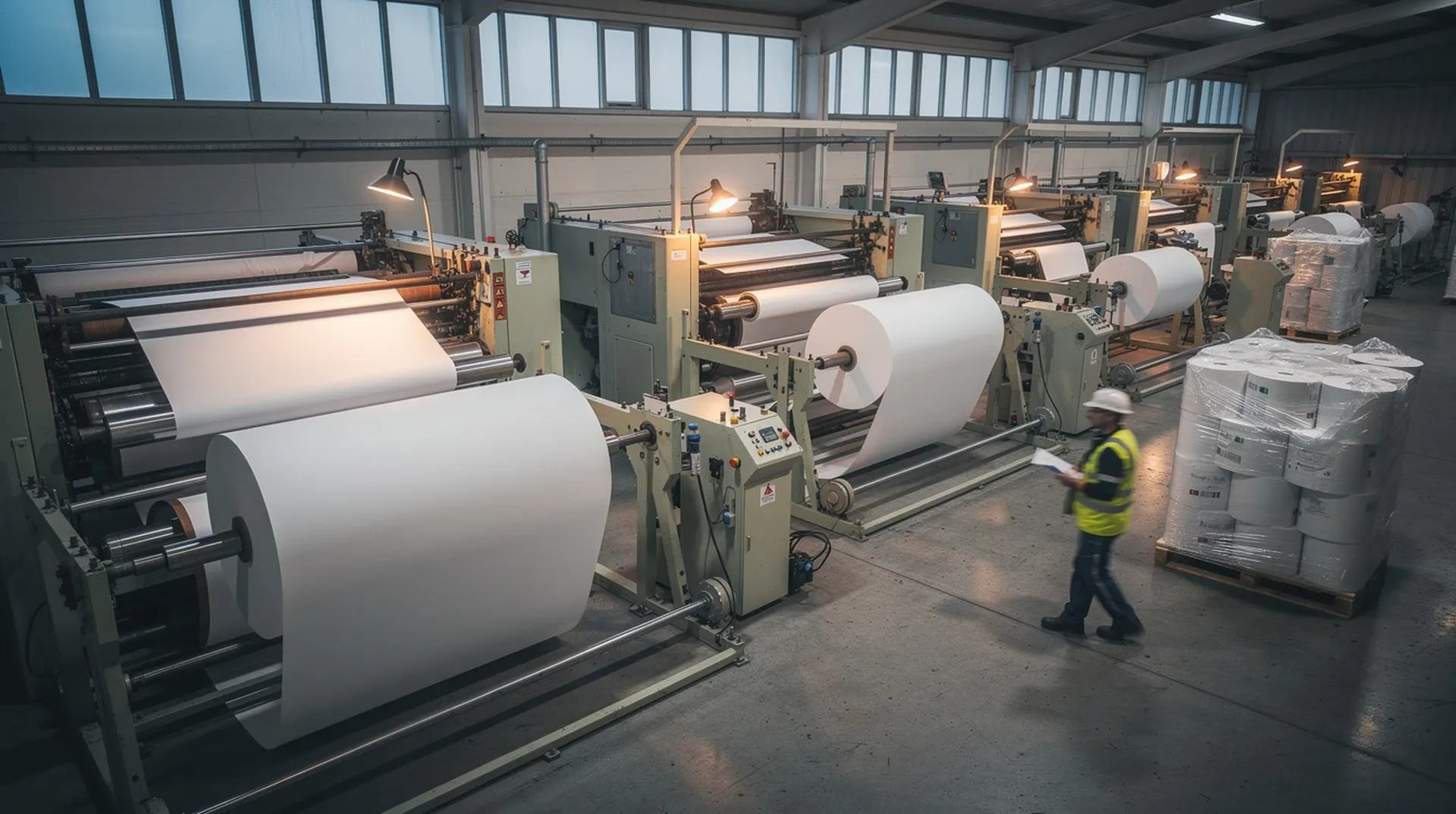
Paper Converting Mastery: How Printing, Coating, and Finishing Transform Packaging Performance
Introduction: From Raw Paper to Functional Packaging
A roll of uncoated kraft paper is just cellulose fiber. It offers minimal protection against moisture, provides no grease resistance, and has no brand presence. The transformation into functional packaging-capable of protecting food, building brands, and surviving real-world conditions-happens through converting processes.
As a paper converter with 50+ years of experience, we've refined these processes across thousands of product iterations. This guide demystifies the technical operations that turn base paper into performance packaging, explaining not just what we do, but why certain approaches work and others fail.
Section 1: Understanding the Converting Process Chain
The Sequential Operations

Paper converting typically follows this sequence:
1. Material Receiving and Quality Control
Incoming base paper inspection
Moisture content verification (critical for dimensional stability)
GSM (grams per square meter) verification
Surface quality assessment
2. Printing (if required)
Plate mounting and registration
Ink preparation and color matching
Print quality control
Drying/curing
3. Coating (if required)
Coating preparation and viscosity control
Application via curtain coater, blade, or rod
Drying via heated cylinders or IR
Coating weight verification
4. Finishing Operations
Slitting to final widths
Sheeting to final dimensions
Die-cutting for custom shapes
Folding, pleating, or creasing
5. Final Quality Control and Packaging
Dimensional verification
Performance testing (moisture, grease resistance)
Migration testing (food contact)
Packaging for shipment
Process Integration Challenges
Why Sequence Matters:
Printing Coating:
Ink must be fully cured before coating application
Coating can affect print appearance (intentional or problematic)
Some coatings enhance print durability
Coating Die-Cutting:
Coating weight affects cutting quality
Too heavy: blunt dies quickly
Too light: inconsistent edges
Coating distribution must be uniform
Moisture Control Throughout:
Paper dimensional changes with moisture content
Each heating process (printing, coating) removes moisture
Must allow equilibration between stages
Final product typically 6-8% moisture content
Section 2: Flexographic Printing Deep Dive
Process Fundamentals
Flexographic printing uses flexible photopolymer plates in direct contact with substrate:
Key Components:
Anilox Roller: Engraved ceramic roller that meters precise ink quantity
Printing Plate: Raised image areas transfer ink to substrate
Impression Cylinder: Provides backing pressure for ink transfer
Drying System: Removes water/solvent from printed surface
Critical Variables Affecting Print Quality
1. Anilox Specification
Measured in:
Lines per inch (LPI): Cell density (higher = finer printing)
BCM (Billion Cubic Microns): Ink volume capacity per square inch
Selection Guidelines:
Solid coverage (logos, blocks): 250-400 LPI, high BCM (3.5-5.0)
Fine text and detail: 500-700 LPI, low BCM (1.5-2.5)
Photo-quality halftones: 800-1000 LPI, very low BCM (1.0-1.5)
Common Error: Using high-LPI anilox for solid coverage results in insufficient ink transfer and washed-out appearance.
2. Printing Plate Considerations
Plate Types:
Analog photopolymer: Traditional, requires film negatives
Digital photopolymer: Direct laser engraving, faster turnaround
Elastomer plates: For specialty applications
Durometer (hardness): Measured in Shore A
Soft plates (30-40 Shore A): Better dot reproduction, shorter life
Medium plates (40-55 Shore A): General purpose
Hard plates (55-70 Shore A): Longer runs, less detail
Plate Mounting Precision:
Registration tolerance: ±0.1mm for multi-color work
Pressure variation across web width must be <5%
Regular calibration essential
3. Substrate Influence
Paper surface affects print quality dramatically:
| Surface Type | Ink Holdout | Print Detail | Typical Applications |
|---|---|---|---|
| Coated (glossy) | Excellent | Excellent | High-quality packaging |
| Coated (matte) | Good | Very good | Food packaging |
| Uncoated smooth | Moderate | Good | Kraft wraps |
| Uncoated rough | Poor | Poor | Rough kraft, newsprint |
Ink Absorption Issues:
Porous substrates absorb ink rapidly dot gain (spreading)
Non-porous substrates keep ink on surface sharp detail but slower drying
Must optimize ink viscosity and drying for substrate
Food-Safe Printing
Migration Concerns:
Food contact printing must prevent chemical migration:
Compliant Ink Systems:
Water-based flexographic inks (our standard)
Low-migration formulations
EUPIA exclusion list compliance (no prohibited substances)
Regular migration testing per framework regulation 1935/2004
Typical Migration Limits:
Overall migration: <10 mg/dm²
Specific substances: Varies (often <0.01 mg/kg food)
Testing Protocol:
Simulate contact conditions (time, temperature, food type)
Analyze migrated substances via GC-MS or LC-MS
Compare to regulatory limits
Document compliance for each product
Cost: £2,000-4,000 per product configuration
Section 3: Coating Technologies
Wax Coating Systems
Melt Coating Process:
Wax Melting: Heat to 70-100°C depending on wax type
Viscosity Control: Maintain optimal temperature (critical)
Application: Curtain coating or roller coating
Cooling: Rapid solidification via chill rollers
Winding: Tension control to prevent blocking
Process Variables:
Coating Weight Control:
Target: ±2 g/m² from specification
Measured: Inline basis weight sensor or offline sampling
Adjustment: Curtain height, roller gap, line speed
Common Problems:
Pinholes: Air bubbles in molten wax
Solution: Degassing, optimal temperature control
Blocking: Finished product sticks together
Solution: Proper cooling, anti-block additives
Strike-through: Wax penetrates substrate
Solution: Lower application temperature, add barrier layer
Line Speed Capabilities:
Small operations: 50-100 m/min
Modern high-speed: 200-400 m/min
Ultra-high-speed (rare): 500+ m/min
Aqueous Coating Systems

Dispersion Coating Process:
Coating Preparation: Mix polymer dispersion to target solids (typically 30-50%)
Viscosity Adjustment: Add water or thickeners
Application: Blade coating or rod coating
Drying: IR heaters or heated rollers
Curing: Some systems require post-drying cure
Advantages:
Lower operating temperature vs. wax (safer, lower energy)
Wide range of properties available
Better recyclability (most formulations)
Challenges:
Slower drying (limits line speed)
More complex process control
Substrate compatibility varies
Process Control:
Solids content: ±0.5% variation affects coating weight significantly
pH control: Many dispersions pH-sensitive (optimal typically 8-9)
Temperature: Both coating and substrate temperature matter
Blade angle and pressure: Affects coating uniformity
Section 4: Die-Cutting and Precision Finishing
Die-Cutting Methods
Rotary Die-Cutting:
Process:
Cylindrical die with cutting rules
Continuous operation (no stop-start)
High speed capability (100-300 m/min)
Applications:
High-volume production
Repeated patterns
Labels, boxes, custom shapes
Economics:
Die cost: £500-2,000 depending on complexity
Setup time: 30-60 minutes
Suitable for runs: >5,000 pieces
Flatbed Die-Cutting:
Process:
Flat die with cutting rules
Reciprocating (stamp) action
Slower than rotary (30-100 strokes/min)
Applications:
Low-volume, high-complexity shapes
Prototyping
Occasional use parts
Economics:
Die cost: £200-800 (lower than rotary)
Setup time: 15-30 minutes
Suitable for runs: <5,000 pieces
Laser Die-Cutting:
Process:
No physical die required
Digital file directly controls laser
Extremely precise (±0.1mm)
Applications:
Prototyping (no die investment)
Ultra-complex shapes
Very low volumes
Economics:
No die cost
Slower than conventional methods
Cost-per-piece higher
Break-even: Typically <500 pieces
Tolerance and Quality Control
Dimensional Tolerances:
| Feature | Standard Tolerance | Tight Tolerance |
|---|---|---|
| Length/width | ±1.0mm | ±0.5mm |
| Cut edge straightness | ±0.5mm | ±0.2mm |
| Registration (print to cut) | ±1.5mm | ±0.75mm |
| Perforation spacing | ±2.0mm | ±1.0mm |
Achieving Tight Tolerances:
Moisture control (biggest variable)
Precision equipment maintenance
Proper die sharpening schedule
Substrate selection (some papers more stable)
Cost Impact: Tight tolerance specification typically adds 10-20% to conversion cost due to:
Increased quality control time
Higher rejection rate
Slower production speeds
More frequent die maintenance
Section 5: Quality Control Systems
Incoming Material Inspection
Critical Parameters:
1. Basis Weight (GSM)
Specification: ±5% typical tolerance
Testing: Cut 100cm² sample, weigh on precision scale
Frequency: Every roll or batch
Impact: Affects coating weight, printing ink transfer, finished product performance
2. Moisture Content
Specification: 6-8% typical range
Testing: Moisture analyzer (infrared or Karl Fischer)
Frequency: Daily or per batch
Impact: Dimensional stability, curl, print registration
3. Caliper (Thickness)
Specification: ±10% typical tolerance
Testing: Micrometer at multiple points
Impact: Die-cutting performance, bulk properties
4. Surface Properties
Smoothness (Bendtsen or Sheffield roughness)
pH (for coating compatibility)
Sizing (water resistance of base paper)
In-Process Monitoring

Print Quality:
Color density (densitometer readings every 100m)
Registration marks (automated camera systems)
Defect detection (inline cameras scanning 100% of web)
Coating Weight:
Inline basis weight measurement
Offline sampling and testing
Target: ±5% from specification
Die-Cutting:
Sample inspection every 500 pieces
Check dimensional accuracy
Verify edge quality (no fraying or raggedness)
Final Product Testing
Food Contact Packaging:
Migration Testing:
Every new product design
Annual verification for existing products
Cost: £2,000-4,000 per test
Performance Testing:
Kit test: Grease resistance
Cobb test: Moisture resistance
Adhesion test: Coating integrity
Tensile strength: Mechanical properties
Section 6: Material Selection Guide
Base Paper Grades
Bleached Kraft:
Properties: High strength, bright white, good printability
Weights: 30-150 gsm typical
Applications: Food wrapping, premium packaging, printing substrates
Cost: £950-1,400/tonne
Unbleached Kraft:
Properties: Natural brown color, maximum strength, renewable image
Weights: 40-200 gsm typical
Applications: Heavy-duty wrapping, industrial packaging, eco-focused brands
Cost: £850-1,200/tonne
Greaseproof Papers:
Properties: Inherent grease resistance (mechanical processing of pulp)
Weights: 30-60 gsm typical
Applications: Bakery, food service where coating not desired
Cost: £1,200-1,800/tonne
MG/MF Tissue:
Properties: Very lightweight, soft texture
MG (Machine Glazed): One smooth side
MF (Machine Finished): Both sides similar
Weights: 17-25 gsm typical
Applications: Gift wrap, tissue paper, interleaving
Cost: £900-1,500/tonne
Selection Decision Tree
Question 1: What mechanical strength is required?
High strength Kraft papers
Moderate strength MG tissue or lightweight kraft
Low strength acceptable MF tissue
Question 2: What appearance is needed?
Bright white Bleached kraft or bleached MG
Natural/eco appearance Unbleached kraft
Color flexibility Any (but bleached takes color better)
Question 3: What barrier properties?
High grease resistance Greaseproof or coated
High moisture resistance Coated
Moderate barriers Base paper + appropriate coating
Question 4: What is price sensitivity?
Budget-conscious Unbleached kraft, MF tissue
Mid-range Bleached kraft
Premium acceptable Specialty grades
Section 7: Process Optimization and Troubleshooting
Common Problems and Solutions
Problem 1: Print Mottle (Uneven Ink Density)
Causes:
Substrate moisture variation
Inadequate impression pressure
Ink viscosity too high or low
Anilox worn or damaged
Diagnosis:
Check substrate moisture (should be 6-8%)
Verify impression pressure (ink transfer must be uniform)
Measure ink viscosity (Zahn cup)
Inspect anilox under magnification
Solutions:
Condition substrate (allow equilibration)
Adjust impression pressure
Correct ink viscosity
Replace or re-engrave anilox
Problem 2: Coating Streaks
Causes:
Contamination on coating blade
Substrate defects (holes, lumps)
Coating viscosity too high
Coating solids too high/inconsistent
Solutions:
Clean blade and coating pan thoroughly
Inspect incoming substrate more carefully
Adjust viscosity
Improve mixing and solids monitoring
Problem 3: Die-Cutting Quality Issues
Edge Fraying:
Dull dies sharpen or replace
Excessive cutting depth adjust
Wrong paper grain direction specify correct orientation
Incomplete Cutting:
Insufficient pressure increase
Die wear sharpen or replace
Substrate thickness variation improve incoming QC
Process Capability Analysis
Statistical Process Control (SPC):
Key Metrics:
Cp (Process Capability): Ratio of specification width to process width
Cpk (Process Capability Index): Accounts for process centering
Target: Cp and Cpk > 1.33 (indicates capable process)
Example: Coating weight specification: 25 ±2 g/m² Actual process standard deviation: 0.8 g/m²
Cp = (Specification width) / (6 × σ) = 4 / (6 × 0.8) = 0.83
Interpretation: Process is NOT capable (Cp < 1.33). Need to improve process control or widen specification.
Section 8: Innovation and Future Technologies
Digital Printing Integration
Advantages:
No printing plates (reduces setup cost and time)
Variable data possible (personalization, serialization)
Very short runs economical
Design iteration rapid
Current Limitations:
Slower speed vs. flexo (30-60 m/min typical)
Higher ink cost per impression
Food contact approval still developing
Color gamut differences vs. flexo
Our Approach:
Hybrid system: Digital for short runs, flexo for production
Currently evaluating digital systems for 2025 installation
Inline Quality Monitoring

Machine Vision Systems:
100% web inspection
Automatic defect detection and classification
Real-time alerts to operators
Data logging for process improvement
Benefits:
Catch defects before reaching customer
Reduce waste
Process improvement insights
Investment: £50,000-150,000 depending on sophistication
Sustainable Process Innovation
Energy Recovery:
Heat recovery from drying systems
Expected energy reduction: 15-20%
Payback: 3-5 years
Water-Based Everything:
Continuing development of water-based coatings with performance parity to solvent systems
Eliminated solvent-based inks (achieved 2018)
Target: Eliminate all solvent-based coatings by 2028
Conclusion: Mastery Through Understanding
Converting paper into functional packaging requires mastering multiple processes, each with dozens of variables affecting final quality. Success comes from:
Deep technical knowledge of process fundamentals
Systematic quality control at every stage
Continuous optimization based on data
Material science understanding for proper selection
Investment in technology to remain competitive
After 50+ years, we've learned that there are no shortcuts. Great packaging comes from great processes, executed consistently, with disciplined quality systems.
For Customers: Understanding these processes helps you specify requirements correctly, appreciate the complexity involved, and recognize when a converter has genuine technical capability vs. just equipment.
Related Articles
Five focused deep-dives that go further on each part of Paper Converting:
Paper Coating Technologies: Wax, Silicone, and Heat-Seal Applications - Compare wax, silicone, and heat-seal coating systems - barrier properties, application methods, end-use suitability.
Die-Cutting and Precision Manufacturing in Paper Converting - Rotary vs flatbed die-cutting, tooling selection, tolerance management, and quality control for precision conversion.
Flexographic Printing for Food-Safe Paper Packaging - Food-safe flexo printing - inks, migration testing, print quality, UK and EU regulatory compliance.
Paper Grades and Properties: A Material Selection Guide - Choose the right paper for the job - kraft, SBS, FBB, recycled, specialty grades and how to match them to applications.
Quality Control in Paper Packaging: Testing, Standards, and Compliance - QC for paper packaging - test methods, ISO and TAPPI standards, food contact compliance, and SPC implementation.
Continue exploring
Quality Control in Paper Packaging: Testing, Standards, and Compliance
Comprehensive guide to QC for paper packaging. Essential test methods, industry standards, food contact compliance, and practical QC implementation for converting operations.
Paper Grades and Properties: A Material Selection Guide
Technical guide to paper selection for packaging. Grade classifications, property specifications, application matching, and selection criteria for optimal performance.
Flexographic Printing for Food-Safe Paper Packaging
Master flexographic printing for food packaging. Food-safe inks, migration testing, print quality parameters, and UK/EU regulatory compliance for converters.
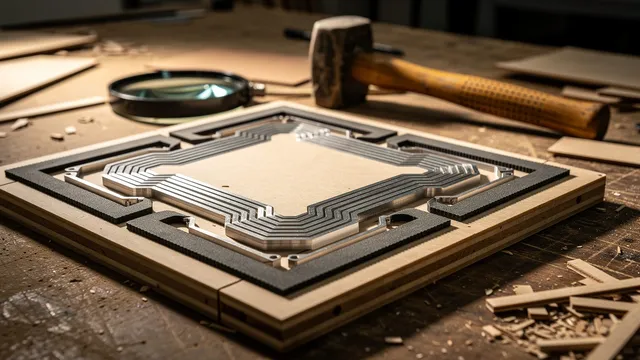
Die-Cutting and Precision Manufacturing in Paper Converting
Technical guide to die-cutting for paper packaging. Rotary and flatbed systems, tooling selection, tolerance management, and quality control for precision converting.
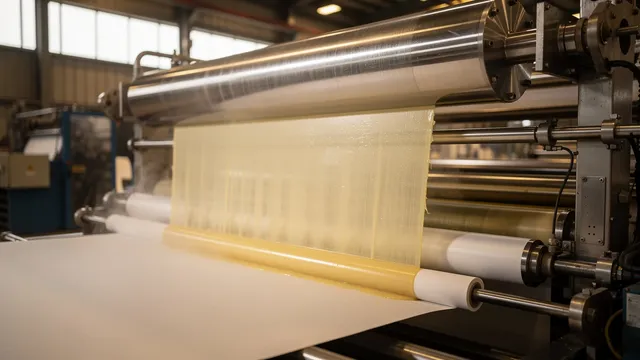
Paper Coating Technologies: Wax, Silicone, and Heat-Seal Applications
Compare wax, silicone, and heat-seal coatings for paper packaging. Barrier properties, release characteristics, sealing performance, and application methods.